
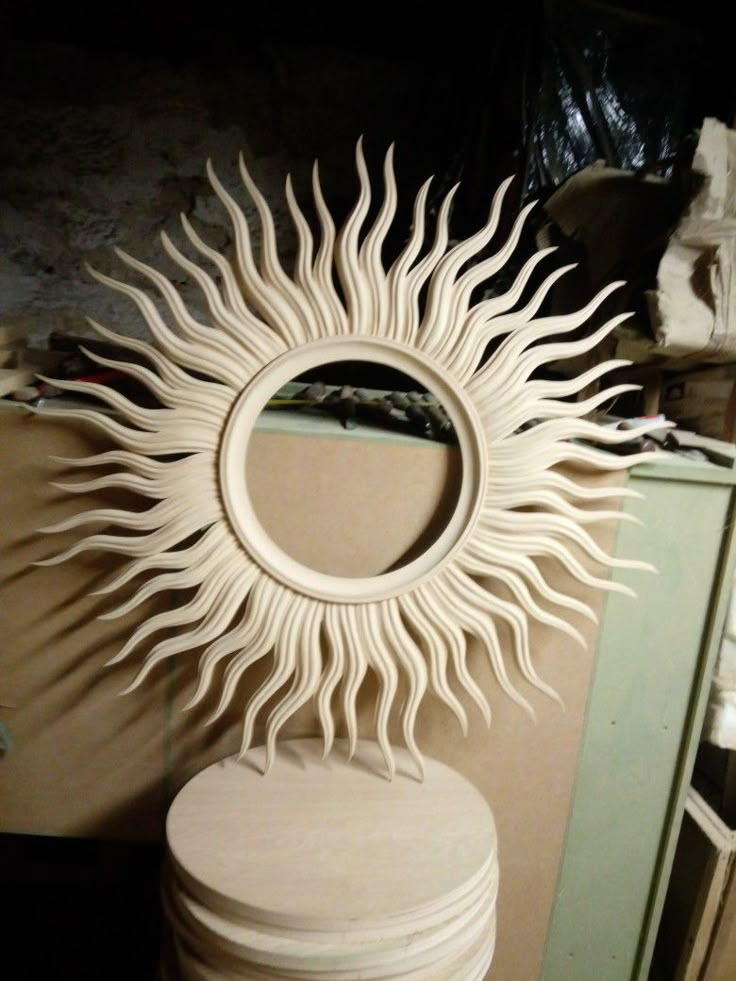
Sunburst carving serves as a powerful focal point in relief work, bridging the gap between abstract geometry and the natural movement of light. This technique utilizes radial symmetry to draw the eye outward, creating a sense of energy and expansion that complements both landscape narratives and standalone decorative pieces.
- Radial Composition: Sunburst designs rely on a central point of origin from which “rays” emanate, a technique often used in mountain reliefs to represent a rising sun or moon behind jagged peaks.
- Depth and Shadow: By alternating the depth of carved rays, artisans can play with light and shadow, making the wooden surface appear to shimmer or glow depending on the angle of the viewer.
- Stylistic Versatility: Whether rendered as clean, geometric lines or as organic, flowing beams of light, the sunburst motif can be adapted to fit modern minimalist panels or traditional rustic landscapes.
- Mixed-Media Potential: These carvings offer an ideal canvas for exploring gold leaf accents or subtle woodburning to enhance the “warmth” of the radial lines.
Mastering the Radiance: Artistic Sunburst Carving Ideas

Sunburst carving is a versatile technique that transforms the natural grain of wood into a dynamic focal point, representing everything from celestial bodies to stylized floral patterns. By manipulating depth, angle, and texture, carvers can create a sense of movement and energy that radiates from a central origin.
- Radial Geometric Precision: Classic sunburst designs utilize clean, mathematically spaced rays that taper toward a central disc, creating a modern and architectural aesthetic.
- Organic and Floral Variations: Beyond traditional suns, the sunburst motif can be adapted into intricate floral forms, such as high-relief sunflowers with jagged, layered petals that add significant physical depth and complexity.
- Mixed-Media Depth: Combining deep relief carving with pyrography (woodburning) allows for enhanced contrast; for instance, burning the valleys between rays can make the raised edges appear to “glow” with artificial light.
- Natural Texture Integration: Advanced carvers often use the natural grain of live-edge slabs to frame sunbursts, allowing the organic lines of the wood to dictate the flow of the outermost rays.
- Atmospheric Perspective: In landscape scenes, a sunburst can be carved with shallow, delicate lines to represent a rising sun, pushing it into the background while deeper carved elements like trees occupy the foreground.
Radial Dynamics: Geometric Precision vs. Organic Flow

The core of any sunburst design lies in how the rays are structured—either as disciplined, mathematical repetitions or as fluid, nature-inspired forms.
Geometric Sunbursts: Order and Energy
Geometric sunbursts utilize precise, symmetrical lines based on mathematical principles to create a sense of order and modern stability.
- Mathematical Layout: These designs are often created by dividing a circle or semicircle into equal degrees, ensuring each “ray” has an identical width at the perimeter.
- Visual Stability: The use of clean edges and predictable angles communicates reliability and strength, making them ideal for architectural focal points or furniture accents.
- Central Disks: Because maintaining perfectly tapered lines toward a single point is difficult, a central raised disk is commonly used as a “hub” for the rays to emerge from.
- Rhythmic Energy: Starburst patterns with radiating rods or elements project a dramatic visual energy, often used to simulate light or movement in minimalist panels.
The Radiance of Wood: Artistic Sunburst and Botanical Carving Ideas

Sunburst and radial botanical designs serve as powerful focal points in woodcraft, utilizing symmetry and depth to create a sense of outward energy. Whether focusing on clean geometric lines or intricate organic forms, these designs transform flat surfaces into dynamic, light-catching art pieces.
Geometric Precision and Radial Symmetry
Radial designs often rely on mathematical spacing to create a balanced, architectural aesthetic.
- Clean Tapered Rays: Traditional sunbursts feature straight or waving rays that taper from a central origin, often used to create mirror frames or decorative wall hangings.
- Anthropomorphic Sun Faces: Incorporating high-relief carving into the central “hub” allows for detailed facial features, such as eyes and high cheekbones, which are then framed by alternating straight and wavy rays.
- Layered Dimensionality: Advanced designs use overlapping elements where some rays appear to sit physically behind others, adding significant 3D depth to the piece.
Anatomy of a Celestial Hub: Progressive High-Relief Carving

.The focal point of a sophisticated sunburst piece is often a figurative hub, which requires a transition from flat geometry to organic, anatomical planes. This process demands a systematic approach to depth to ensure the facial features appear to emerge naturally from the wood.
The Foundations of Facial Relief
The “Facet” Roughing Phase: Before rounding the features, the carver uses a gouge to create flat, angled facets across the cheeks and forehead, providing a structural guide for the eventual smooth curves.
Initial Plane Mapping: The carving begins on a circular wooden blank where basic anatomical markers—the brow line, nose bridge, and mouth—are sketched and shallowly cut to establish the primary composition.
Establishing Recession: Depth is created by carving away the areas for the eye sockets and the corners of the mouth, leaving the nose and cheeks as the highest points on the relief.
The Art of the Silhouette: Vertical Forest Pyrography

This latest series of nature studies demonstrates how pyrography can be used to create deep atmospheric perspective on vertical wood slabs. By varying the intensity of the burn, these pieces move beyond simple sketches into high-contrast environmental narratives.
High-Contrast Evergreen Silhouettes
- Density and Detail: These studies utilize heavy carbonization to create bold, black silhouettes of pine and fir trees, capturing the jagged, irregular patterns of the needles against the light wood grain.
- Centralized Composition: On live-edge slabs, the trees are often clustered in the center, allowing the natural unburnt wood to act as a glowing “sky” that draws the eye inward.
- Structural Variety: The artist captures different species by varying the branch structure, from the dense, triangular weight of a mature fir to the spindly, reaching limbs of younger saplings.
Sunburst Frames and Radial Carving

Large-scale radial designs are often utilized for functional art, requiring precise repetition and deep relief to create movement.
- Ornate Flame-Like Rays: Intricate mirror frames feature dozens of hand-carved, wavy rays that mimic flickering flames, radiating outward from a central circular void.
- Shadow and Depth: Each individual ray is carved with deep central channels and raised edges, ensuring that light catches the peaks and creates dramatic shadows in the valleys.
- Symmetry and Balance: Achieving a professional finish requires exact spacing around the perimeter, maintaining a consistent “S-curve” for every radiating element.
Radial Wood Art: From Mirror Frames to Figurative Relief

The latest collection of images showcases the diversity of radial woodcarving, spanning from large-scale functional frames to detailed anthropomorphic hubs and intricate botanical sunbursts.
Sculptural Sunburst Frames
- Flame-Like Geometry: Frames feature dozens of hand-carved, wavy “S-curve” rays that radiate from a central circular void, designed to mimic flickering light or flames.
- Dimensional Channels: Each ray is carved with deep central grooves and sharp, raised edges, allowing light to catch the peaks and create dramatic shadows in the valleys.
- Polished Finishes: Finished pieces, like the large wall-mounted mirror, show a warm, smooth wood finish that accentuates the grain as it follows the undulating curves of the rays.
Architectural and Modular Sunbursts
- Functional Carpentry: Sunburst designs can be scaled for large architectural features, such as deck railings, where linear wooden slats radiate from a semi-circular base to create a structural suncatcher.
- Modular Construction: For large-scale wall art, wavy rays can be cut as individual wooden components and arranged around a central circular hub before final carving and assembly.
- Geometric Starbursts: Small-scale projects often begin with a mathematically divided block, where straight-line layouts are carved into tapered, multi-dimensional star patterns.
Sunburst Deck Railing: Architectural Symmetry

The architectural sunburst serves as a structural focal point for outdoor spaces, using linear wooden slats to create a radiating pattern.
- Radial Construction: Straight wooden boards are positioned at varying angles, all emerging from a central semi-circular hub at the base of the railing.
- Framed Integration: The radiating “rays” are secured within a rectangular top and bottom rail, creating a stable and safe barrier for decks or balconies.
- Natural Contrast: The design utilizes pressure-treated wood, where the visible grain and knots of the lumber add a rustic, organic texture to the precise geometric layout.
Radial Woodcraft: From Structural Suncatchers to Sculptural Art
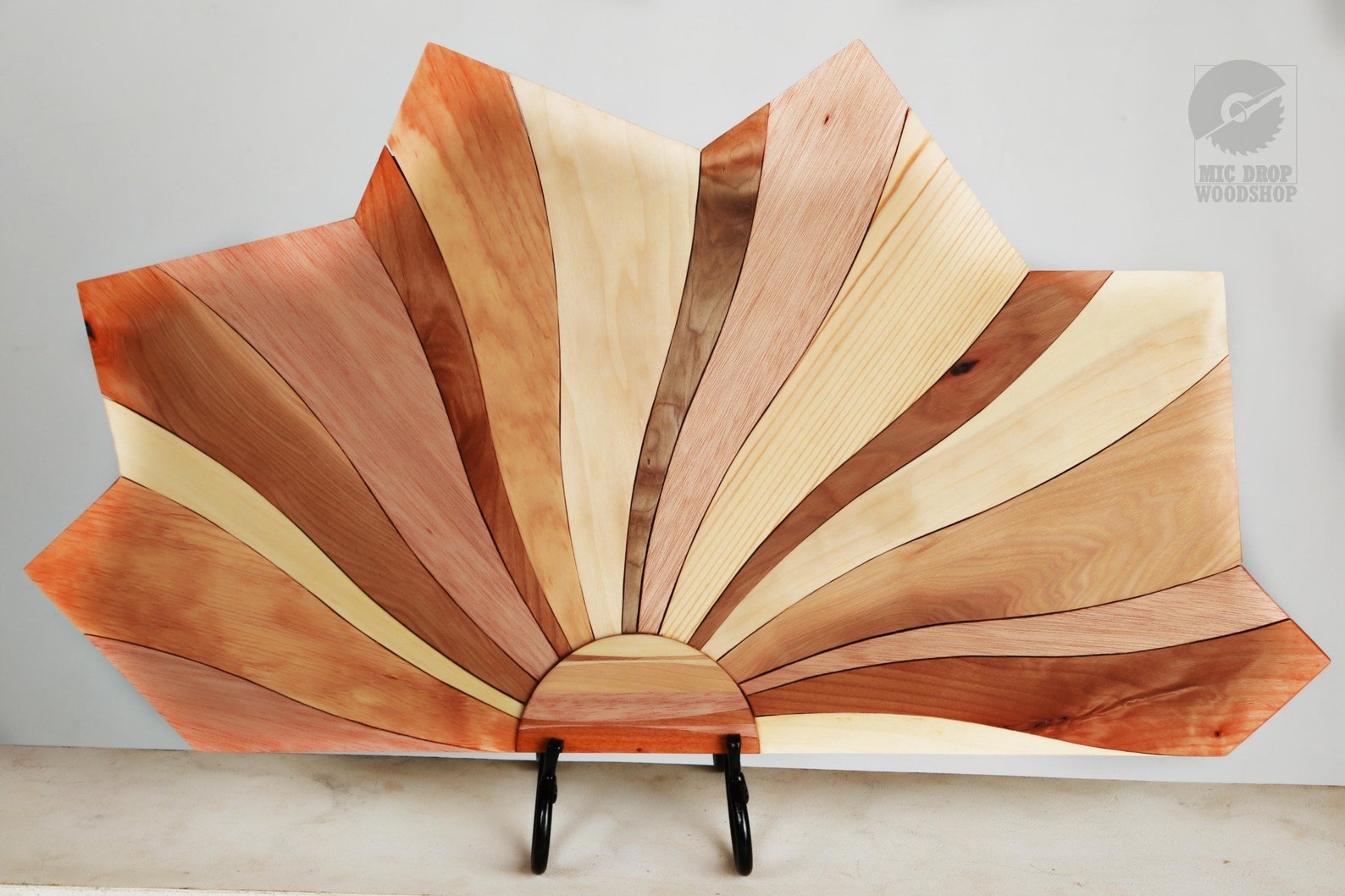
The sunburst motif in woodcraft ranges from structural architectural features to highly expressive decorative sculptures. These designs leverage radial symmetry to create a sense of outward energy and movement across various scales.
Sunbursts can be integrated into functional carpentry or created as standalone art through different assembly methods:
- Architectural Railings: For outdoor decks, linear wooden slats are arranged to radiate from a central semi-circular hub, providing a structural yet decorative safety barrier.
- Modular Assembly: Complex sunbursts are often built by cutting individual “S-curved” rays and dry-fitting them around a central hub before final carving and glue-up.
- Tonal Inlay Panels: Decorative wall art can be created by sequencing tapered wedges of different wood species—such as purpleheart, cedar, and oak—to simulate a multi-colored sunrise.
The Enduring Radiance of Radial Woodcraft
The evolution of the sunburst motif demonstrates the unique ability of wood to bridge the gap between rigid architectural structure and fluid artistic expression. Whether it is the rhythmic precision of a deck railing or the nuanced personality of a high-relief sun face, these designs remain grounded in the universal appeal of radial symmetry.
- Technical Versatility: The transition from simple geometric layouts to complex modular assemblies allows artisans to scale the sunburst concept for any environment.
- Material Storytelling: By utilizing varied wood species and tonal inlays, carvers can simulate the organic movement of light, turning static panels into vibrant narratives of sunrise and warmth.
- Sculptural Mastery: The progressive refinement of figurative hubs and ornate frames proves that with patient tooling, a simple wooden blank can achieve breathtaking depth and character.
Through these diverse techniques, the sunburst continues to be a timeless centerpiece in the world of woodworking, celebrating both the hand of the maker and the natural beauty of the timber.