
As the frost of winter fades, there is no better way to welcome the season of renewal than with simple rabbit carving ideas for spring decor. Rabbits are a quintessential symbol of spring, representing growth and vitality. Their soft, rounded forms and recognizable silhouettes make them an ideal subject for woodcarvers of all levels. Whether you are looking to create a whimsical centerpiece for your Easter table or a series of small “pocket companions” to tuck into seasonal gift baskets, carving a rabbit allows you to explore graceful curves and charming expressions in a meditative way.
The beauty of these projects lies in their approachable simplicity. By focusing on a “slow carving” philosophy, we move away from the pressure of complex anatomy and instead lean into the rhythmic, calming process of shaping wood. These designs prioritize clean lines and basic geometric shapes, making them perfectly accessible for beginners while offering seasoned carvers the creative freedom to add personality through ear placement and tail textures.
Project Profile: The Faceted Honey-Oak Rabbit

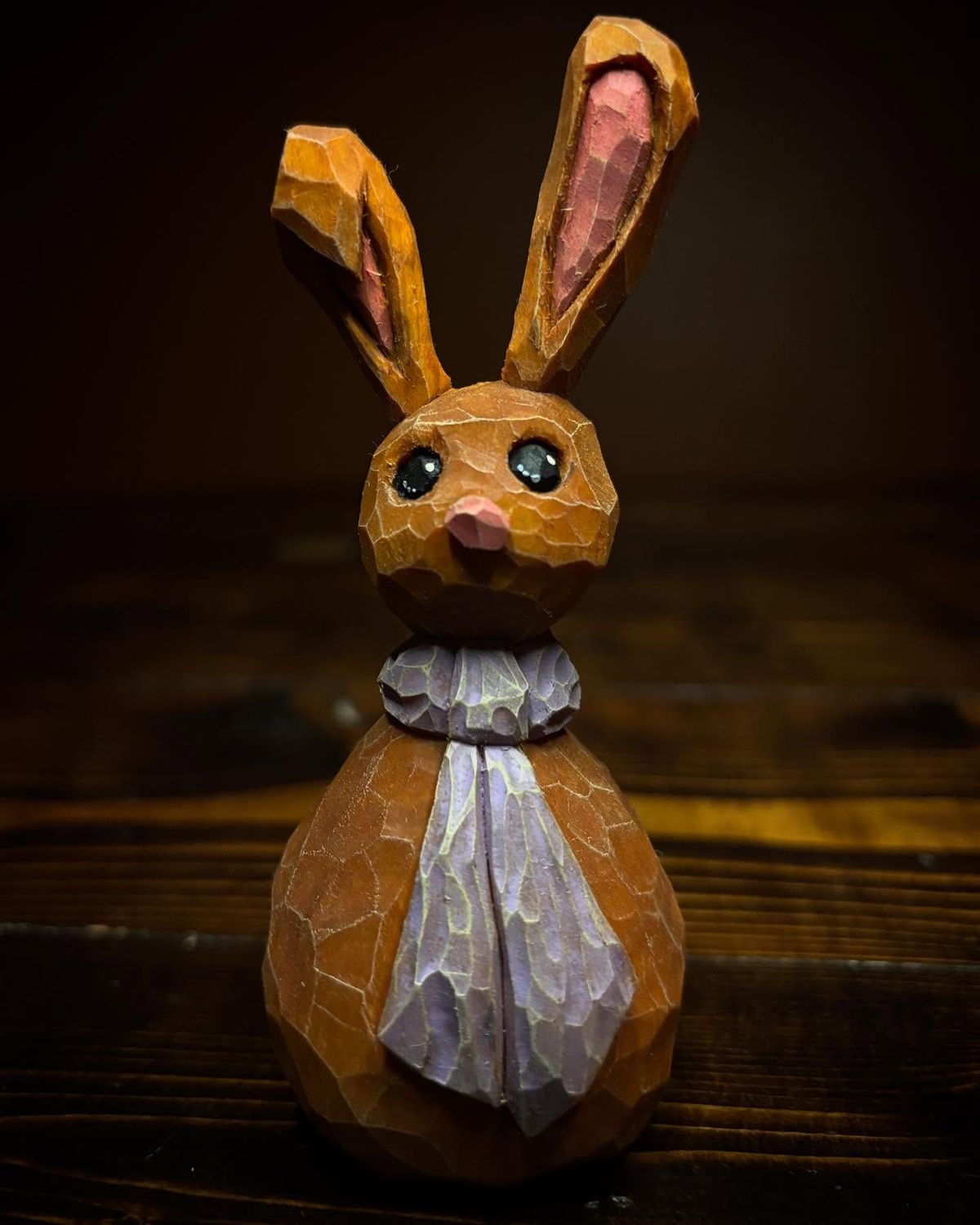
This piece is a masterclass in the “Slow Carve” philosophy, focusing on a textured, faceted finish rather than a sanded-smooth surface. The deliberate knife marks catch the light, giving this spring rabbit a rustic, hand-hewn charm that feels both modern and traditional.
- Design Style: A chunky, “kawaii-inspired” silhouette featuring an oversized head, large upright ears, and a simplified round body.
- Slow Carving Focus: The primary goal here is surface consistency. Instead of removing large chunks of wood, you are practicing small, uniform flat-plane cuts. Each facet should be roughly the same size, creating a honeycomb effect that covers the entire body.
- Skill Practice: This project hones your grain management skills. Because the ears are tall and thin, you must carve slowly toward the tips to avoid splintering the delicate wood fibers. It also introduces basic painting on wood, using a “stain-wash” to keep the grain visible while adding a pop of pink to the ears and nose.
- Difficulty Level: Beginner. The simple stacked-sphere shape is very forgiving, making it a perfect starting point for new carvers.
- Key Tooling: A flat-blade whittling knife for the facets and a small v-tool for the subtle curves of the closed eyes and mouth.
Project Profile: The Faceted Spring Bunny

This project is an excellent follow-up to our introductory designs, focusing on a clean, “low-poly” aesthetic. By leaving the knife marks visible, you create a rustic, hand-hewn texture that celebrates the artisan’s touch without the need for extensive sanding.
- Design Style: An upright, stylized rabbit with oversized ears and a simplified, rounded body.
- Slow Carving Focus: The goal here is geometric consistency. You are practicing making small, uniform flat-plane cuts across the entire surface to create a rhythmic, faceted pattern.
- Skill Practice: This piece hones your grain management. Because the ears are tall and thin, you must carve slowly and deliberately toward the tips to prevent splintering. It also serves as a great canvas for a “stain-wash,” where you add a pop of pink to the ears while keeping the natural wood grain visible.
- Difficulty Level: Beginner. The stacked-sphere anatomy is very forgiving and easy to block out.
- Key Tooling: A flat-blade whittling knife for the body facets and a small v-tool for the subtle curves of the eyes and mouth.
Project Profile: The Polished Rosewood Hare

This project transitions from the textured, faceted look to a smooth, ergonomic finish. It is a lesson in patience, demonstrating how slow carving and progressive sanding can transform a simple block into a piece of decor that feels like a precious gemstone in the hand.
- Design Style: A “crouching” or tucked rabbit silhouette that emphasizes compact, flowing lines and a high-gloss finish to highlight the rich wood grain.
- Slow Carving Focus: The focus here is on seamless transitions. You are carving away the “steps” between the legs, ears, and body to create a single, continuous organic form.
- Skill Practice: This piece is an exercise in sanding as a carving tool. Once the rough shape is established, you practice “slow sanding”—moving through progressively finer grits (from 80 to 1000+)—to remove every tool mark and reveal the wood’s deep luster.
- Difficulty Level: Intermediate. While the shape is simple, the hard grain of darker woods like rosewood or walnut requires sharp tools and a steady hand to avoid tear-out.
- Key Tooling: A curved spoon gouge for the concave areas around the ears and neck, and a polishing cloth with beeswax for the final protective glow.
Project Profile: The Faceted Honey-Oak Bunny

This project is a perfect entry point for the “Slow Carve” method, emphasizing clean, visible knife marks that celebrate the hand-made nature of the piece.
- Design Style: A “kawaii-inspired” silhouette with an oversized head, large upright ears, and a simplified round body.
- Slow Carving Focus: The primary goal is surface consistency. Practice making small, uniform flat-plane cuts to create a rhythmic honeycomb effect across the entire body.
- Skill Practice: This piece hones grain management, particularly when carving toward the thin tips of the ears to prevent splintering. It also introduces a “stain-wash” technique to add color while keeping the grain visible.
- Difficulty Level: Beginner.
- Key Tooling: A flat-blade whittling knife for the facets and a small v-tool for the subtle curves of the eyes and mouth.
Project Profile: The Faceted Honey-Oak Bunny

This project is a perfect entry point for the “Slow Carve” method, emphasizing clean, visible knife marks that celebrate the hand-made nature of the piece.
- Design Style: A “kawaii-inspired” silhouette with an oversized head, large upright ears, and a simplified round body.
- Slow Carving Focus: The primary goal is surface consistency; practice making small, uniform flat-plane cuts to create a rhythmic honeycomb effect across the entire body.
- Skill Practice: This piece hones grain management, particularly when carving toward the thin tips of the ears to prevent splintering. It also introduces a “stain-wash” technique to add color while keeping the grain visible.
- Difficulty Level: Beginner.
- Key Tooling: A flat-blade whittling knife for the facets and a small v-tool for the subtle curves of the eyes and mouth.
Project Profile: The Faceted Honey-Oak Bunny

This project is a perfect entry point for the “Slow Carve” method, emphasizing clean, visible knife marks that celebrate the hand-made nature of the piece.
- Design Style: A “kawaii-inspired” silhouette with an oversized head, large upright ears, and a simplified round body.
- Slow Carving Focus: The primary goal is surface consistency; practice making small, uniform flat-plane cuts to create a rhythmic honeycomb effect across the entire body.
- Skill Practice: This piece hones grain management, particularly when carving toward the thin tips of the ears to prevent splintering. It also introduces a “stain-wash” technique to add color while keeping the grain visible.
- Difficulty Level: Beginner.
- Key Tooling: A flat-blade whittling knife for the facets and a small v-tool for the subtle curves of the eyes and mouth.
Project Profile: The Faceted Honey-Oak Bunny

This project is a perfect entry point for the “Slow Carve” method, emphasizing clean, visible knife marks that celebrate the hand-made nature of the piece.
- Design Style: A “kawaii-inspired” silhouette with an oversized head, large upright ears, and a simplified round body.
- Slow Carving Focus: The primary goal is surface consistency; practice making small, uniform flat-plane cuts to create a rhythmic honeycomb effect across the entire body.
- Skill Practice: This piece hones grain management, particularly when carving toward the thin tips of the ears to prevent splintering. It also introduces a “stain-wash” technique to add color while keeping the grain visible.
- Difficulty Level: Beginner.
- Key Tooling: A flat-blade whittling knife for the facets and a small v-tool for the subtle curves of the eyes and mouth.
Project Profile: The Faceted Honey-Oak Bunny

This project is a perfect entry point for the “Slow Carve” method, emphasizing clean, visible knife marks that celebrate the hand-made nature of the piece.
- Design Style: A “kawaii-inspired” silhouette with an oversized head, large upright ears, and a simplified round body.
- Slow Carving Focus: The primary goal is surface consistency; practice making small, uniform flat-plane cuts to create a rhythmic honeycomb effect across the entire body.
- Skill Practice: This piece hones grain management, particularly when carving toward the thin tips of the ears to prevent splintering. It also introduces a “stain-wash” technique to add color while keeping the grain visible.
- Difficulty Level: Beginner.
- Key Tooling: A flat-blade whittling knife for the facets and a small v-tool for the subtle curves of the eyes and mouth.
Project Profile: The Faceted Honey-Oak Bunny

This project is a perfect entry point for the “Slow Carve” method, emphasizing clean, visible knife marks that celebrate the hand-made nature of the piece.
- Design Style: A “kawaii-inspired” silhouette with an oversized head, large upright ears, and a simplified round body.
- Slow Carving Focus: The primary goal is surface consistency; practice making small, uniform flat-plane cuts to create a rhythmic honeycomb effect across the entire body.
- Skill Practice: This piece hones grain management, particularly when carving toward the thin tips of the ears to prevent splintering. It also introduces a “stain-wash” technique to add color while keeping the grain visible.
- Difficulty Level: Beginner.
- Key Tooling: A flat-blade whittling knife for the facets and a small v-tool for the subtle curves of the eyes and mouth.
Project Profile: The Faceted Honey-Oak Bunny

This project is a perfect entry point for the “Slow Carve” method, emphasizing clean, visible knife marks that celebrate the hand-made nature of the piece.
- Design Style: A “kawaii-inspired” silhouette with an oversized head, large upright ears, and a simplified round body.
- Slow Carving Focus: The primary goal is surface consistency; practice making small, uniform flat-plane cuts to create a rhythmic honeycomb effect across the entire body.
- Skill Practice: This piece hones grain management, particularly when carving toward the thin tips of the ears to prevent splintering. It also introduces a “stain-wash” technique to add color while keeping the grain visible.
- Difficulty Level: Beginner.
- Key Tooling: A flat-blade whittling knife for the facets and a small v-tool for the subtle curves of the eyes and mouth.
Conclusion: Bringing Your Spring Collection to Life
As you complete these simple rabbit carving ideas for spring decor, you’ve done more than just create seasonal ornaments; you’ve practiced the art of patience through the Slow Carve method. From the rhythmic, uniform facets of the Honey-Oak Bunny to the delicate, high-precision relief work required for the Face & Eye Study, each piece has served as a milestone in your technical development.
Whether you choose to display the Polished Rosewood Hare as a sophisticated centerpiece or tuck the whimsical Hatching Egg Rabbits into festive baskets, your collection now reflects a diverse range of styles. You’ve mastered grain management on delicate ears, explored asymmetrical balance with folded poses, and even tackled integrated carving by combining subjects like rabbits and carrots.
These carvings are a testament to the beauty of handmade craft. As spring arrives, let these wooden companions serve as a reminder of the growth and renewal you’ve achieved at your carving bench.