
Pyrography, or “writing with fire,” offers a sophisticated way to capture the fluid grace and complex textures of the feline form. Unlike traditional carving, which relies on physical depth, woodburning utilizes varying temperatures and specialized nibs to create a range of tones—from the softest whisper of fur to the deep, dark intensity of a predator’s gaze. By shifting our focus to the heat-based silhouette, we can explore how light and shadow define a cat’s personality, allowing for a level of detail that brings the wood’s surface to life.
In this series, we emphasize the Slow Burn technique, where patience and precision are paramount. Success in feline pyrography is found in the layering of heat; starting with pale, delicate outlines and gradually building to the rich, scorched blacks that provide contrast and depth. Whether you are working on a rustic live-edge slice or a polished plank, these designs provide a structured path for refining your ability to translate animal life into the permanent, scorched medium of wood.
The Macro-Perspective Profile

This project moves away from full silhouettes and into the realm of “macro” portraiture, using only one half of a feline’s face to create an intense and artistic composition.
Design Style: A realistic, side-profile close-up of a cat’s face, focusing on the eye, nose, and whiskers while leaving the left half of the board entirely blank.
Slow Carving Focus: The priority for this piece is fine-texture gradients; by working slowly around the bridge of the nose and the eye, you practice creating the illusion of short, dense fur through thousands of tiny, individual heat strokes.
Skill Practice: This project is an excellent study in negative space and light. You will practice using the natural pale tone of the wood to represent the brightest highlights in the eye and the tips of the long, sweeping whiskers.
Difficulty Level: Advanced.
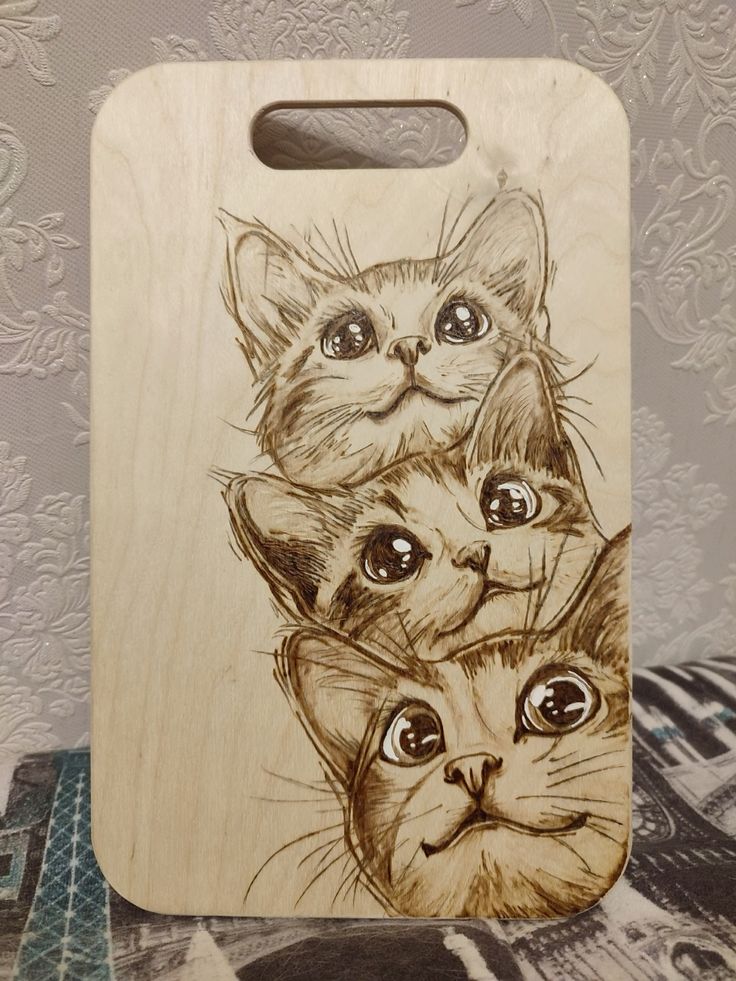
The Pyrography Triple-Portrait

For those looking to combine woodburning with artistic detail, this project focuses on capturing life and depth through shading on a smooth wooden surface.
- Design Style: A vertical stack of three realistic kitten faces, each with oversized, shimmering eyes and detailed whisker patterns.
- Slow Carving Focus: The focus is on surface preparation and micro-shading. The wood must be sanded to an ultra-smooth finish to allow the pen to glide effortlessly.
- Skill Practice: This project hones your detail precision. You practice creating varied line weights—thick for the pupils and noses, and incredibly fine for the individual hairs—to create a sense of life.
- Difficulty Level: Intermediate. Success depends on a steady hand and understanding how heat creates smooth gradients on the grain.
- Key Tooling: A pyrography (woodburning) pen with various tips for shading and fine lines.
Project Profile: The Peeking “Counter-Top” Kitten

This project explores humor and character positioning, using high-contrast pyrography to create a design that appears to interact with its physical environment.
- Design Style: A whimsical “peeking” cat appearing over the edge of a wooden board, accompanied by humorous etched text.
- Slow Carving Focus: This is an exercise in composition and framing. The artist must position the paws and ears carefully to create the illusion that the cat is physically gripping the edge of the wood.
- Skill Practice: This piece hones negative space management. By leaving large areas of natural wood untouched and using dark burns for the subject, you create a bold graphic effect.
- Difficulty Level: Beginner to Intermediate. While the burning is straightforward, the precision required for the “grip” of the paws requires careful planning.
- Key Tooling: A flat shading tip for large dark areas and a ball-point pyrography tip for the circular eyes and text.
The Wildlife Portrait Planks

This project moves away from domestic silhouettes and explores the intense, detailed world of big cat portraiture using advanced pyrography techniques. It focuses on using the vertical space of long wooden boards to create balanced, professional compositions.
- Design Style: Intricate, realistic portraits of a Leopard and a Cheetah family, integrated with floral and butterfly motifs to create a cohesive vertical scene.
- Slow Carving Focus: The priority for these pieces is tonal mapping and texture layering. Before applying heat, the wood surface must be sanded to a glass-like finish, allowing the pyrography pen to glide without snagging on the grain.
- Skill Practice: This piece is a masterclass in fine-line precision. You will practice varying heat intensities to distinguish between the soft, velvety texture of the ears, the sharp “tearmarks” of the Cheetah, and the complex rosettes of the Leopard.
- Difficulty Level: Advanced.
- Key Tooling: A variable-temperature pyrography station is essential. Use a fine-wire detail nib for fur and whiskers, and a spoon-shading nib for the soft gradients in the flowers and facial shadows.
The Botanical Feline Portrait

This project moves beyond simple silhouettes into the realm of decorative portraiture, focusing on how to frame a feline subject with organic floral elements to create a balanced, artistic composition.
- Design Style: A side-profile portrait of a domestic cat nestled within a crescent-shaped arrangement of flowers, leaves, and dotted accents.
- Slow Carving Focus: The priority for this piece is tonal mapping and delicate outline work, ensuring the cat’s profile remains the focal point while the botanical details provide supporting texture.
- Skill Practice: This project hones point-tip precision for the fine, sweeping whiskers and the stippled “dotted” accents that add a sense of movement and airiness to the design.
- Difficulty Level: Intermediate.
- Key Tooling: A fine-point pyrography nib is essential for the sharp facial outlines and whiskers, while a universal shading tip can be used to add soft depth to the flower petals and ear shadows.
The Peeking Companion Plank

This project focuses on the creative use of space and character positioning to make a design feel as though it is interacting directly with the viewer. It is an excellent study in combining portraiture with cursive script.
- Design Style: A playful composition featuring two “peeking” cats—one appearing from the side and another from the bottom—accompanied by large-format cursive text that fills the vertical space of the board.
- Slow Carving Focus: The priority for this piece is compositional balance and script consistency. Achieving smooth, flowing lines for the long-form text requires a steady hand and a slow, deliberate movement of the woodburning pen.
- Skill Practice: This project hones your ability to manage negative space. By positioning the subjects at the extreme edges of the plank, you practice drawing the eye across the entire surface of the wood.
- Difficulty Level: Intermediate.
- Key Tooling: A ball-point pyrography tip is ideal for the cursive lettering, while a fine detail nib is used to create the layered texture in the cats’ fur and the expressive, large-pupil eyes.
The Live-Edge Kitten Medallion

This project focuses on adapting a silhouette to a circular, natural wood surface, using deep, saturated burns to create a bold graphic effect.
- Design Style: A wide-eyed kitten peering over the bottom edge of a round, live-edge wood slice, accompanied by a small, delicate butterfly focal point.
- Slow Carving Focus: The priority is gradient control on raw grain; because live-edge rounds often have uneven density, you must move the pen slowly and deliberately to ensure the solid black areas of the fur are uniform and saturated.
- Skill Practice: This piece hones circular composition. You will practice centering the kitten’s features to work with the natural rings of the wood while using the butterfly to balance the empty vertical space.
- Difficulty Level: Beginner to Intermediate.
- Key Tooling: A heavy shading nib is used to fill in the large, dark areas of the forehead and ears, while a fine-point tip is necessary for the delicate antennae of the butterfly and the thin whiskers.
Project Profile: The Outlined Kitten Portrait

This project emphasizes the power of a bold, consistent outline to define a subject’s character. It is an excellent study for those wanting to practice steady line work and expressive facial features without the complexity of full-body shading.
- Design Style: A cheerful, sitting kitten portrait featuring bold, dark outlines that emphasize a fluffy coat and a bright, alert facial expression.
- Slow Carving Focus: The priority is consistent line weight; by moving the pen slowly and with steady pressure, you ensure the thick borders around the fur and paws remain uniform, providing a professional “sticker-like” graphic effect.
- Skill Practice: This piece hones fine-detail linework within the face. You will practice creating the thin, tapering lines of the whiskers and the delicate inner-ear details that give the kitten its lively personality.
- Difficulty Level: Beginner.
- Key Tooling: A fixed-point or ball-tip pyrography nib is ideal for maintaining the thick, consistent outlines, while a fine-detail wire nib is used for the precision work in the eyes and whiskers.
The Bow-Tie Kitten Portrait

This project focuses on the intersection of clean animation-style outlines and traditional woodburning, emphasizing expressive facial features and soft, flowing curves.
- Design Style: A whimsical, stylized kitten portrait featuring large, expressive eyes and a large bow tied behind the neck, rendered with bold, consistent outlines.
- Slow Carving Focus: The priority is thermal line consistency; by moving the wire nib at a steady pace, you ensure that the thick outer borders and the delicate inner curves of the eyes and bow remain uniform in color and depth.
- Skill Practice: This piece is excellent for practicing variable line weights. You will learn to use the tip of the nib for fine details like eyelashes and whiskers, while using slightly more pressure or heat for the structural outlines of the body.
- Difficulty Level: Beginner.
- Key Tooling: A fine-wire detail nib is the primary tool for this design, allowing for the precise control needed to capture the kitten’s inquisitive gaze and the intricate folds of the bow.
The Ballerina Pop-Icon Portrait

This project moves into the world of popular culture, demonstrating how to use thick, saturated outlines and soft internal shading to recreate a clean, recognizable character.
- Design Style: A playful, stylized portrait of a popular cat character dressed as a ballerina, featuring a signature bow and a ruffled tutu.
- Slow Carving Focus: The priority is border saturation; you must move the pen at a very slow, consistent pace to ensure the thick outlines are deeply charred and uniform, providing the high-contrast “pop” necessary for this graphic style.
- Skill Practice: This piece hones gradient shading for textures. You will practice using a lower heat setting or a shading nib to create the soft, smoky shadows in the ruffles of the tutu and the bow, giving a three-dimensional feel to an otherwise flat design.
- Difficulty Level: Beginner.
- Key Tooling: A rounded ball-tip nib is ideal for creating thick, smooth outlines, while a flat shader tip is used to apply the soft, grey-toned shadows in the decorative clothing elements.
Conclusion: Bringing Your Feline Collection to Life
As we conclude these easy cat woodburning and portrait ideas, you’ve explored a vast range of ways to celebrate feline grace through the art of the burn. From the hyper-detailed, life-like gaze captured in the Wildlife Portrait Planks to the striking macro views that play with light and shadow, each technique offers a unique way to hone your pyrography skills.
By following the Slow Burn philosophy, you’ve practiced essential woodburning foundations:
- Thermal Shading: You have mastered the gradients needed for life-like fur, expressive eyes, and the intricate rosettes found on wild felines.
- Compositional Framing: You’ve learned to use botanical motifs, live-edge circles, and interactive “peeking” placements combined with cursive script to create balanced art.
- Outline Precision: You’ve practiced creating bold, graphic characters—ranging from realistic kittens to whimsical pop-culture icons with decorative accents.
These feline companions, whether domestic, wild, or whimsical, serve as a beautiful testament to the versatility of your woodburning tools. As you display your finished boards or share them as gifts, let them reflect the patience, heat control, and artistic growth you’ve achieved at the bench.