
In the world of wood carving, there is a distinct difference between “getting it done” and “slow carving.” While our whale projects were about capturing dynamic movement for decor, turtle carving is the ultimate exercise in patience and precision. Because a turtle is a creature that embodies a slow, steady pace, it serves as the perfect subject for carvers looking to quiet their minds and master the “meditative stroke.”
For a beginner, a turtle isn’t just a project; it’s a skills-builder. The shell requires repetitive, rhythmic patterns that build muscle memory, while the slow transition from the heavy body to the delicate head teaches you how to respect the wood’s grain without rushing.
In this series, we aren’t racing toward a finished product. We are focusing on:
- Deliberate Motion: Making every chip of wood intentional.
- Grain Awareness: Learning to feel the wood’s resistance before you even make a cut.
- Textural Patterns: Using the turtle’s shell to practice geometric and organic detailing at a relaxed pace.
Slow Carve Project Profile: The Rough-Out Turtle Duo

This first stage is the most important part of “slow carving” because it requires you to resist the urge to rush into the details. These two blanks (shown in your latest image) provide a solid foundation for a meditative practice.
- Design Style: A basic “aerial view” silhouette, featuring a wide, circular carapace and blocky extensions for the head and flippers.
- Practice Focus: Symmetry and Proportion. * The Shell: Use this stage to slowly round the sharp vertical edges of the “circle” into a gentle dome. Focus on making the dome even on all sides.
- The Flippers: Practice making identical “V” cuts to separate the limbs from the main body, ensuring each flipper has the same thickness.
- Difficulty Level: Absolute Beginner (Foundation Stage).
- Key Tooling: A sturdy roughing knife or a small palm chisel to remove the bulk wood around the pencil guidelines.
- Pro Tip for Slow Carving: Instead of trying to carve the final shape immediately, take “paper-thin” shavings. This allows you to observe the grain direction change as you move around the circular shell, preventing the wood from splintering.
Project Profile: The Geometric Snap-Turtle Duo

This stage is the heart of slow carving practice, moving from basic shapes to high-detail, textured surfaces. These two carvings show how patient, repetitive cuts transform a blocky silhouette into a piece with prehistoric character.
- Design Style: A rugged, “low-poly” geometric design that emphasizes the armor-like look of snapping turtles.
- Slow Carving Focus: The shell is the ultimate meditative exercise. Instead of sanding it smooth, you practice dozens of individual “chip cuts” to create the raised, faceted plates.
- Skill Practice: This piece teaches you how to maintain crisp edges on the head and tail without accidentally rounding them over.
- Difficulty Level: Intermediate Beginner. The challenge is the sheer number of repetitive cuts and maintaining focus across multiple sessions.
- Key Tooling: A V-tool is essential for defining the deep lines between the shell plates, while a detail knife refines the sharp angles of the beak.
Project Profile: The Sea Turtle Corner-Block Template

This stage is the foundation of slow carving, where you learn to visualize a 3D creature hidden within a 2D corner of wood. It is the perfect exercise for practicing spatial awareness and planning your grain direction before the first chip is removed.
- Design Style: A classic sea turtle silhouette with elongated front flippers, designed to wrap around the 90-degree corner of a rectangular wood block.
- Slow Carving Focus: The goal here is “pre-carving” visualization. By sketching the head and shell along the corner ridge, you are training your eye to use the natural geometry of the wood to create depth.
- Skill Practice: This step emphasizes precise pencil work and symmetry. It teaches beginners to respect the wood’s dimensions and plan for the thickest parts of the carving, like the central dome of the shell.
- Difficulty Level: Absolute Beginner (Planning Phase). No tools are required yet, making this a stress-free entry point into the project.
- Key Tooling: A standard mechanical pencil for fine lines and a steady hand to ensure the spine of the turtle aligns perfectly with the corner of the block.
Project Profile: The Detailed Sea Turtle

This piece marks the transition from basic shapes to intricate surface detailing. It challenges the carver to maintain a “slow carve” mindset while executing the delicate patterns of a sea turtle’s anatomy.
- Design Style: A realistic, swimming sea turtle featuring a raised carapace and defined limb scutes.
- Slow Carving Focus: The shell is the primary exercise here. Instead of simple lines, you are carving individual, interlocking scutes. This requires a patient, methodical approach to ensure each plate has a slight 3D relief.
- Skill Practice: This stage introduces “texture layering.” You are practicing how to carve fine, scaly details on the flippers and head, which requires a much lighter touch and frequent knife stropping to maintain a razor edge.
- Difficulty Level: Intermediate. The challenge is coordinating the deep relief of the shell with the fine, shallow detailing of the skin.
- Key Tooling: A v-gouge for the shell channels and a fine-point detail knife for the eye and flipper texture.
Project Profile: The Painted Masterpiece Sea Turtle

This final stage celebrates the transition from wood sculpture to a lifelike piece of art. It demonstrates how “slow carving” principles extend into the finishing phase, where patience in layering color is just as vital as patience with the knife.
- Design Style: A fully realized, realistic sea turtle with an anatomical focus on the complex color patterns found in nature.
- Slow Finishing Focus: The goal here is “textural painting.” Instead of solid blocks of color, you are using fine brushes to apply individual spots and scute highlights. This methodical process mimics the slow, rhythmic nature of the carving itself.
- Skill Practice: This piece teaches you to respect the “highs and lows” of your carving. You are practicing how to use light-colored paint in the deep grooves to emphasize the 3D relief of the shell and head.
- Difficulty Level: Advanced Beginner / Intermediate. The challenge shifted from removing wood to applying precise, intricate detail without obscuring the carved textures underneath.
- Key Tooling: Ultra-fine detail brushes and acrylic paints. A matte sealant is used at the very end to protect the delicate paintwork while keeping the natural look of the turtle.
Project Profile: The Upright Long-Neck Tortoise

This character-driven piece is a fantastic slow carving exercise that shifts focus from anatomical realism to expressive, vertical storytelling. It challenges the carver to manage a delicate, extended neck while maintaining a solid, grounded base.
- Design Style: A whimsical, upright tortoise featuring a highly elongated neck and a multi-tiered, segmented shell.
- Slow Carving Focus: The primary challenge here is the neck. Carving such a thin, vertical element requires extreme patience and light pressure to avoid snapping the wood grain. It serves as an excellent lesson in structural integrity.
- Skill Practice: This project emphasizes “faceted” carving. Instead of sanding the body smooth, you are practicing leaving intentional, clean knife marks that define the musculature of the legs and the segments of the shell, giving the piece a rustic, hand-hewn texture.
- Difficulty Level: Intermediate. The vertical orientation and the fragility of the neck require a more advanced understanding of wood grain than horizontal sea turtle designs.
- Key Tooling: A thin-blade detail knife is essential for shaping the small head and refining the narrow neck area without putting too much torque on the wood.
Here are the project credentials for the final image in your turtle carving ideas for slow carving practice series.
Project Profile: The High-Gloss Painted Tortoise
This final piece showcases the beautiful result of combining meticulous carving with layered painting techniques. It serves as a great example of how a slow, methodical approach to both the knife and the brush creates a professional-grade collectible.
- Design Style: A realistic, fully-sculpted tortoise with a high-domed shell and a detailed green body, resting on a decorative carving knife handle.
- Slow Carving Focus: The shell segments are deeply defined, practicing the “rounding over” of individual plates to create a natural, aged texture.
- Skill Practice: This project emphasizes advanced finishing techniques, specifically “dry-brushing” lighter tones over a darker base to highlight the raised textures of the shell and skin.
- Difficulty Level: Advanced Beginner / Intermediate. The complexity lies in managing the multi-tone paint application and achieving a smooth, high-gloss protective finish.
- Key Tooling: A fine-point detail knife for the small facial features and a variety of small, soft-bristle brushes for layering acrylic colors.
Project Profile: The Chainsaw Tortoise Rough-Out

This project scales up the “slow carving” philosophy, proving that even with power tools, success comes from deliberate, mindful movement. This large-scale tortoise (seen in your latest image) is an exercise in managing heavy wood while maintaining the same focus on geometry as the smaller pieces.
- Design Style: A robust, large-format tortoise featuring deep, blocky shell segments and prominent, charred eyes for a striking high-contrast look.
- Slow Carving Focus: On this scale, “slow” means constant assessment; after every major cut with the chainsaw, you must stop to re-evaluate the symmetry and proportions of the heavy log.
- Skill Practice: This piece teaches you how to translate small-scale geometric patterns (like the snapping turtle shell) onto a much larger surface, requiring you to use your whole body for control rather than just your wrists.
- Difficulty Level: Intermediate to Advanced. The challenge lies in safely handling power equipment while still achieving the fine, expressive details in the head and beak.
- Key Tooling: A battery-operated chainsaw (like the STIHL MSA 140 C shown) for the primary mass removal and a blowtorch for “burning in” the dark details of the eyes and beak.
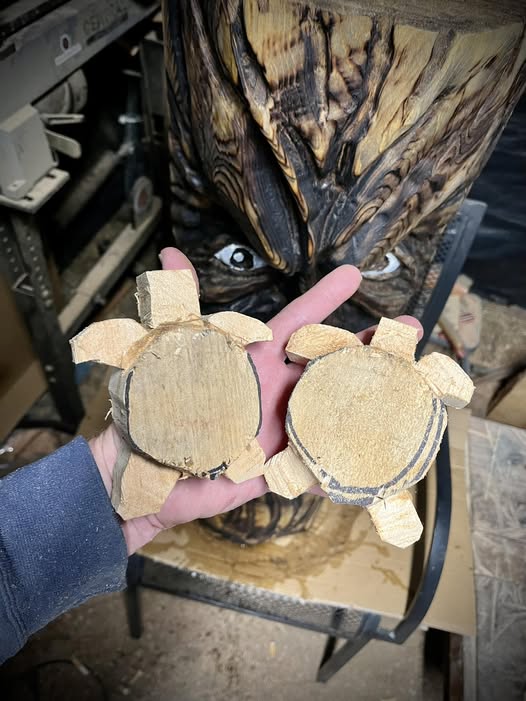
Project Profile: The Twin Land Tortoise Rough-Outs

These two carvings represent the bridge between a raw blank and a high-detail masterpiece. They are the perfect stage for a slow carver to practice consistent, shallow cuts to create a uniform surface before any intricate textures are added.
- Design Style: A classic, low-profile land tortoise with a smooth, domed carapace and thick, grounded flippers.
- Slow Carving Focus: The carapace is the highlight here. Practice using a “stop-cut” and a shallow shave to define the individual scutes of the shell without digging too deep into the wood.
- Skill Practice: This stage focuses on symmetry across pairs. By carving two identical turtles simultaneously, you train your hands and eyes to replicate shapes and depths exactly.
- Difficulty Level: Beginner to Intermediate. The challenge lies in the precision required to keep both turtles identical in scale and detail.
- Key Tooling: A small palm gouge for the curved shell segments and a sharp whittling knife for refining the head and neck.
The Slow Carve Progression

Across these projects, we have moved through several key stages of development:
- Foundation & Planning: Starting with corner-block templates to visualize anatomy within the wood’s natural geometry.
- Geometric Repetition: Utilizing stylized, faceted shell designs to build consistent muscle memory and precision with the knife.
- Advanced Detailing: Progressing to realistic sea turtles where “texture layering” on flippers and individual scutes requires a delicate, patient touch.
- Scale & Finishing: Exploring everything from small-scale painted collectibles to large-format rough-outs that require deliberate, whole-body control.
Whether you are carving a simple round whale or an intricate snapping turtle, the goal remains the same: to create a lasting, hand-hewn piece that brings a sense of warmth and accomplishment to your space.
Project Profile: The Step-by-Step Vertical Tortoise

This image serves as a comprehensive visual roadmap for the slow carving process, demonstrating the transition from a raw wooden block to a characterful, upright figure. It emphasizes that carving is a series of logical, patient decisions.
- Design Style: An upright, stylized tortoise that utilizes a vertical block orientation to maximize height and presence.
- Slow Carving Focus: The progression from Step 1 to Step 4 highlights the “reductive” nature of carving. It encourages the carver to focus on one phase at a time—from initial sketching to rough massing—before ever touching the fine details.
- Skill Practice: This overview is a masterclass in form definition. It teaches you how to block out major components like the head, shell, and base separately, ensuring the structural proportions are sound before you commit to the final shape.
- Difficulty Level: Beginner to Intermediate. While the final shape looks complex, the step-by-step breakdown makes it approachable for anyone willing to follow a methodical pace.
- Key Tooling: A large roughing knife for the initial mass removal in Step 3 and a detail knife for the refined facets seen in the final Step 4 stage.
The Slow Carve Progression
Across these projects, we have moved through several key stages of development:
- Foundation & Planning: Using corner-block templates to visualize a 3D creature within the natural geometry of a 90-degree ridge.
- Geometric Repetition: Utilizing stylized, “low-poly” snapping turtle designs to practice consistent, rhythmic chip cuts that build muscle memory.
- Advanced Detailing: Progressing to realistic sea turtles where the focus shifts to “texture layering” on flippers and individual interlocking scutes.
- Scale & Finishing: Exploring a wide range of outcomes, from large-scale chainsaw rough-outs requiring whole-body control to high-gloss painted tortoises that utilize layered color to enhance 3D relief.
By following the step-by-step roadmap from a raw block to a faceted upright figure, you have demonstrated that successful carving is a series of logical, patient decisions. Whether you are creating a simple “smiling” whale for a nursery or a detailed tortoise masterpiece, the goal remains the same: to find focus and quiet the mind through every intentional stroke of the knife.