
Scroll through any homeschooling group online and you will find the same question asked over and over: what does your school room look like? It gets asked because the physical space matters — not in a superficial, interior-design way, but in a deeply practical one. The room where your children learn every day shapes how they feel about learning, how independently they can work, how focused they stay, and how sustainable the whole enterprise is for you as the parent running it.
But most homeschool room articles stop at the pretty pictures. They show you an aspirational space, give it a vague label, and move on. What they rarely do is explain why a room works — what specific decisions were made, what problems those decisions solve, and how you might apply the same thinking to your own home, whether you have a dedicated room, a shared space, or just a corner of the kitchen.
This guide is different. Each of the ten rooms below illustrates a specific design principle — something actionable you can take away and apply regardless of your budget, your floor plan, or how many children you are teaching. Some of these rooms are spacious and purpose-built. Others are a kitchen table. All of them are working.
Before You Design: The Questions That Should Come First
Most homeschooling parents approach room design backwards. They find images they love, buy furniture to match, and then discover the space doesn’t work for how their family actually learns. Before you spend anything or move anything, answer these four questions honestly:
How many children are you teaching, and what are their ages? A room that works beautifully for one eight-year-old will be completely inadequate for three children spanning ten years of schooling. Age range determines how many distinct workstations you need, how much floor space independent play requires, and whether your storage needs to be child-accessible or adult-managed.
What is your teaching style? A structured, schedule-driven approach needs different things from a space than an unschooling or Charlotte Mason method. If you teach mostly at a whiteboard, you need wall space and sightlines. If your children work independently for long periods, you need focused individual workstations. If learning happens through projects and hands-on activities, you need surfaces and storage that can handle mess and materials.
Do you have a dedicated room, or are you sharing space? This is the most important practical question, and the answer shapes every decision that follows. A dedicated room gives you permission to design a permanent setup. A shared space requires furniture that can be cleared, folded, or repurposed at the end of the school day. Neither is better — but they require completely different approaches.
What is your honest budget? A homeschool room does not need to be expensive. Some of the most functional setups in this guide cost almost nothing. But knowing what you can spend before you start prevents the common trap of buying aspirational furniture that doesn’t survive daily use, or investing in organisation systems that don’t fit the actual dimensions of your space.
10 Ready to Go Homeschool Room Ideas
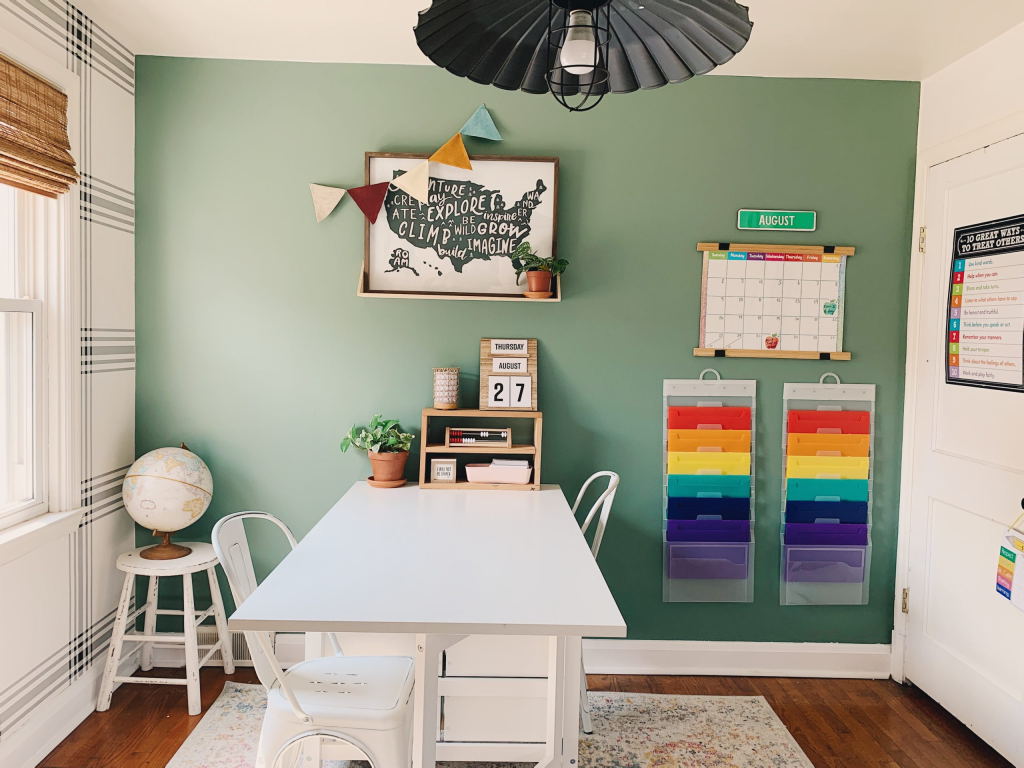
1. Use an Accent Wall to Define the Learning Zone You don’t need a separate room to create a dedicated classroom feel — sometimes a single bold paint colour does the job. The sage green wall here immediately signals “this is the school space,” separating it visually from the rest of the home without a single partition. The wall also becomes a functional surface: a calendar for routine, colour-coded file organizers for each subject, and motivational word art that keeps the day’s purpose in view. If your homeschool shares a room with another function, one strong accent wall can do all of this work.
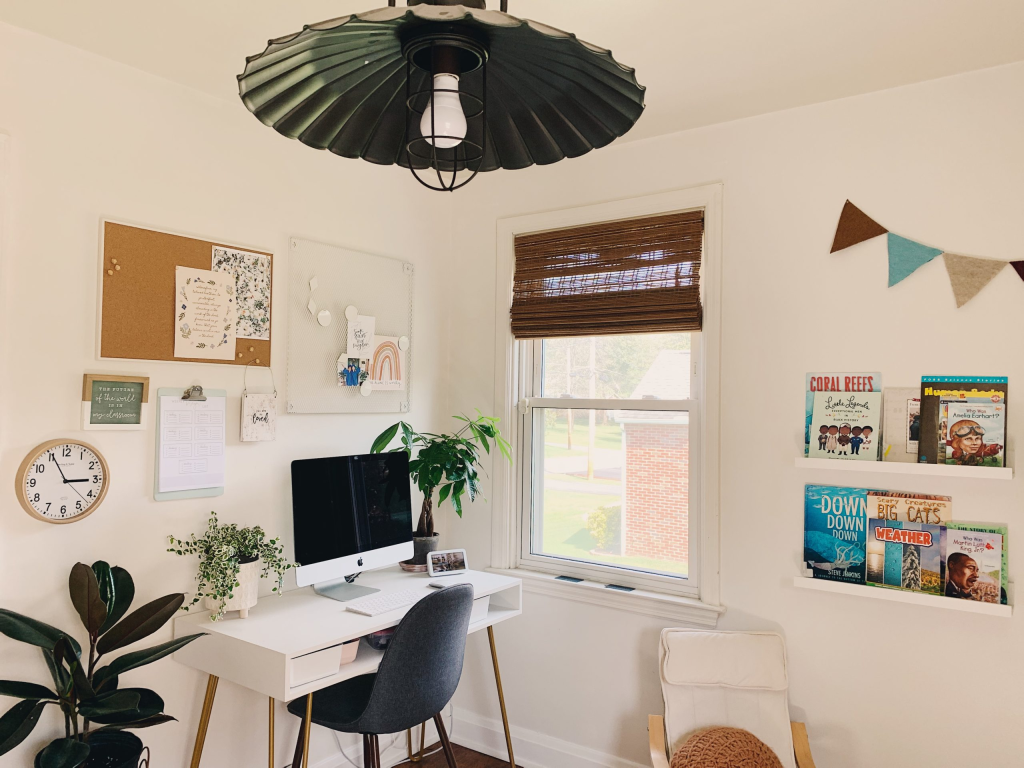
2. Build Around Natural Light The most important decision in this room wasn’t the furniture — it was placing the main workstation directly facing the window. Natural light reduces eye strain during screen-heavy lessons, lifts mood across a long school day, and makes the entire space feel larger and more inviting than any lamp can. The rest of the room follows that lead: white walls, minimal clutter, and plants that reinforce the connection to the outdoors. If you have one good window, build your desk setup around it.
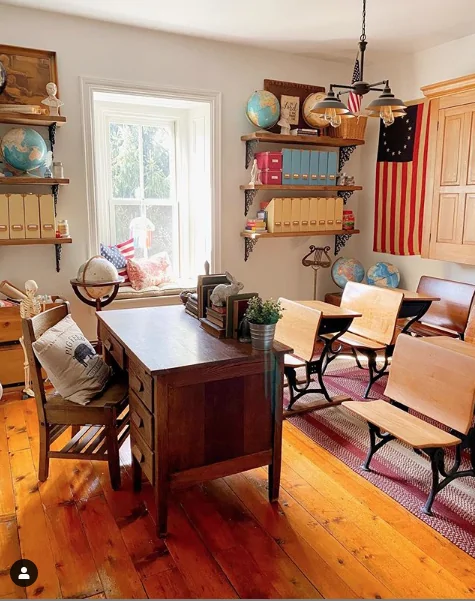
3. Let the Aesthetic Do the Teaching A room styled to look and feel like a real schoolhouse sends a powerful daily message to children: learning is a serious, worthwhile pursuit with a long history. Antique student desks, a teacher’s desk, vintage globes, and open shelves of matching binders create an environment where the atmosphere itself becomes part of the curriculum. You don’t need to replicate this exactly — but deliberately choosing furniture and decor that communicates respect for learning shapes how children show up to it.
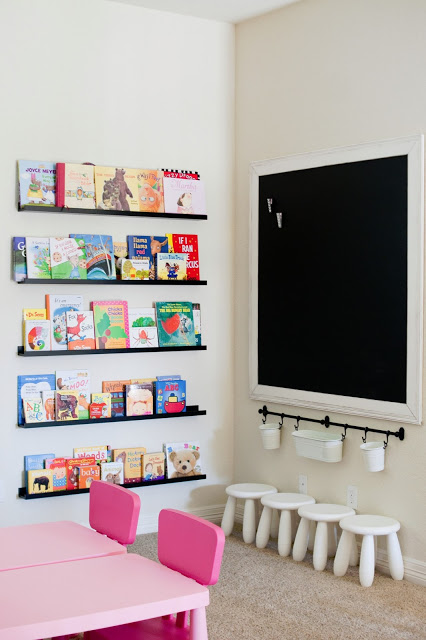
4. Design Specifically for Young Learners Early years homeschooling has different physical requirements than older grades, and this room is designed accordingly. Books are displayed face-out so a pre-reader can find them independently by cover. The table and stools are child-height so small bodies sit comfortably without dangling feet. The chalkboard is low on the wall and within easy reach. When a space is scaled and organised for the child rather than the adult, it builds independence — children can access their own materials, make their own choices, and take ownership of their learning without waiting for help.
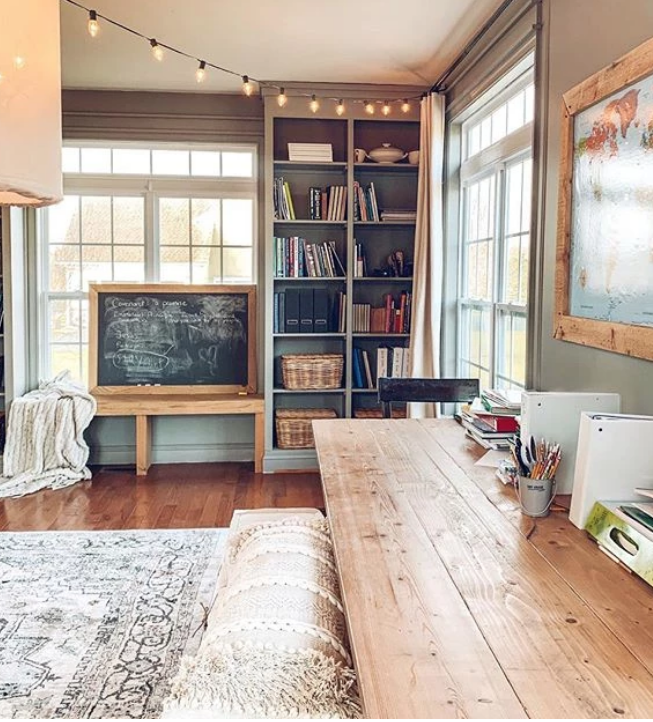
5. Give Every Activity Its Own Zone This farmhouse room works because it separates the work into distinct areas rather than trying to do everything at one surface. The long table is for seated group work. The freestanding chalkboard is for teaching and demonstration. The bookshelf is the library. The rug defines a floor space for reading or gathering. When children move between zones, they physically transition between modes — and that movement helps them mentally shift gears too. If you have the space, zoning is one of the most effective things you can do for focus and flow.
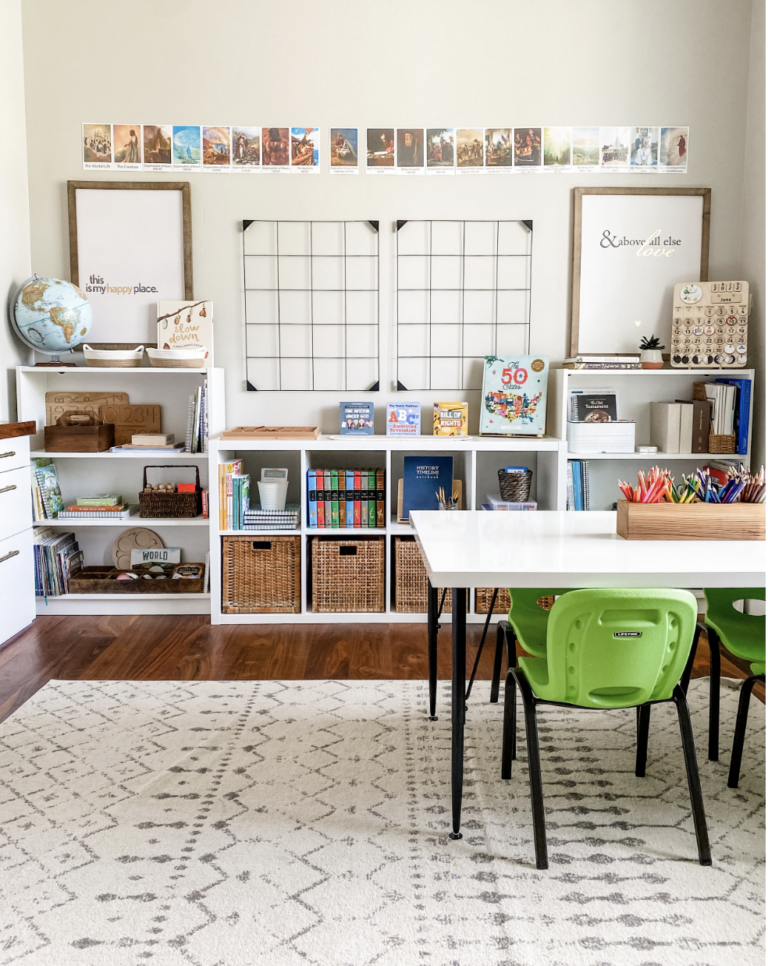
6. Make the Storage System the Design In a home with multiple children and multiple curricula, visible and consistent organisation is not optional — it is the room. This setup demonstrates exactly that: white shelving units hold every book, basket, binder, and supply in a system that can be read and maintained by the children themselves. When storage is this intentional, the room essentially runs itself. Children know where things live, can retrieve and return materials independently, and spend lesson time learning rather than searching. Investing in a unified storage system upfront saves daily friction for years.
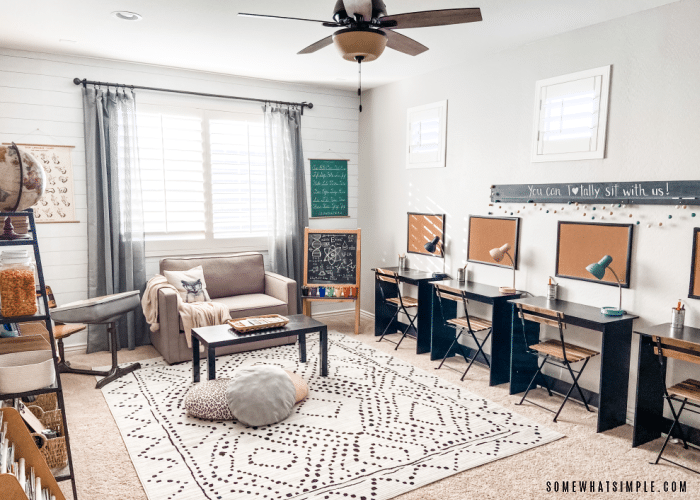
7. Plan for Multiple Children at Different Levels One of the biggest design challenges in homeschooling is creating a room that works simultaneously for children at different ages and stages. This room solves it by splitting the space into two distinct areas: individual desks for focused independent work, and a shared sofa and coffee table zone for read-alouds, group lessons, or downtime between subjects. Neither area competes with the other. If you are teaching more than one child, designing zones with different functions — rather than trying to make one table serve every purpose — is the most practical thing you can do.
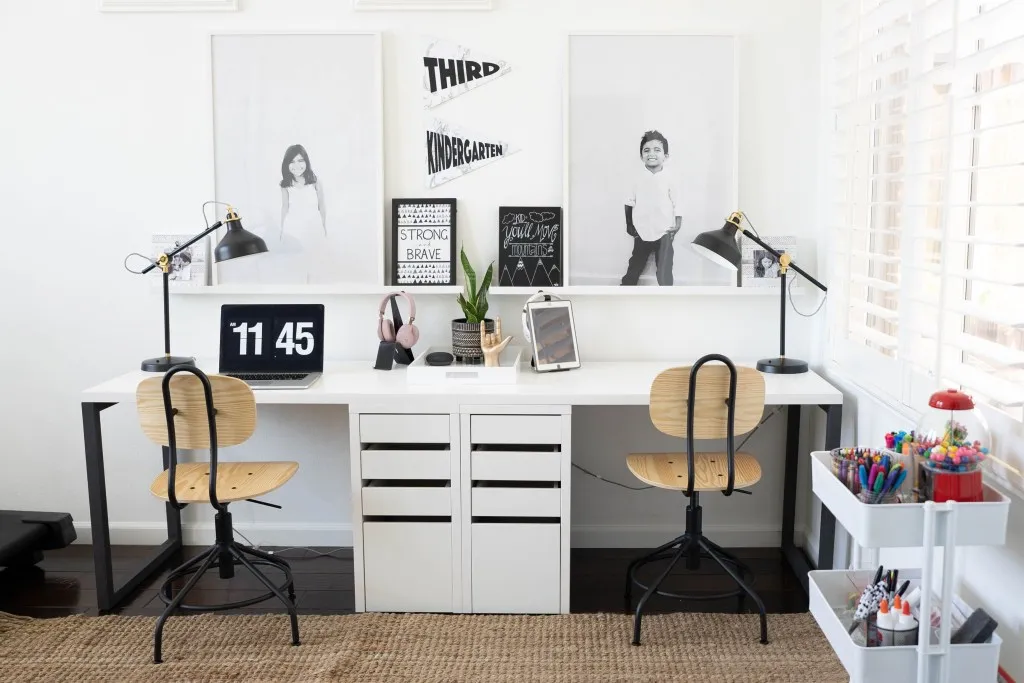
8. Give Each Child Their Own Defined Space When siblings share a homeschool room, the fastest way to avoid conflict and encourage focus is to give each child unambiguous ownership of their own area. This setup does that with a shared desk that is clearly divided: each child has their own lamp, their own drawers, and — most powerfully — their own large portrait photograph above their workspace. That personal touch transforms a generic desk into my desk, and the difference in engagement and care that comes from that sense of ownership is significant. It does not require much space — just deliberate boundaries.
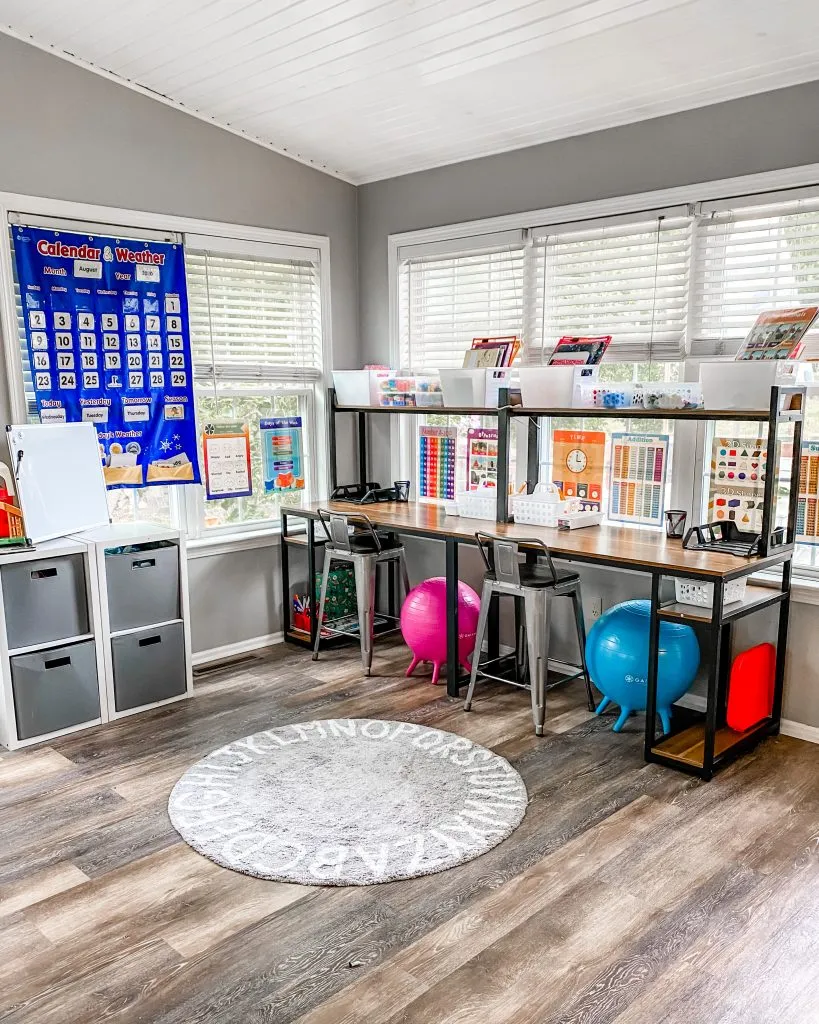
9. Design for the Way Your Child’s Body Actually Works Some children genuinely cannot sit still for extended periods — and fighting that reality makes everyone’s day harder. This room accepts it and designs around it: balance ball chairs and bar-height stools give children the option to shift, bounce, or perch throughout the day, channelling physical energy without disrupting learning. Research consistently supports movement-friendly seating for improving focus in kinaesthetic learners. If your child struggles to sit through lessons, the problem may not be attention — it may be the chair.
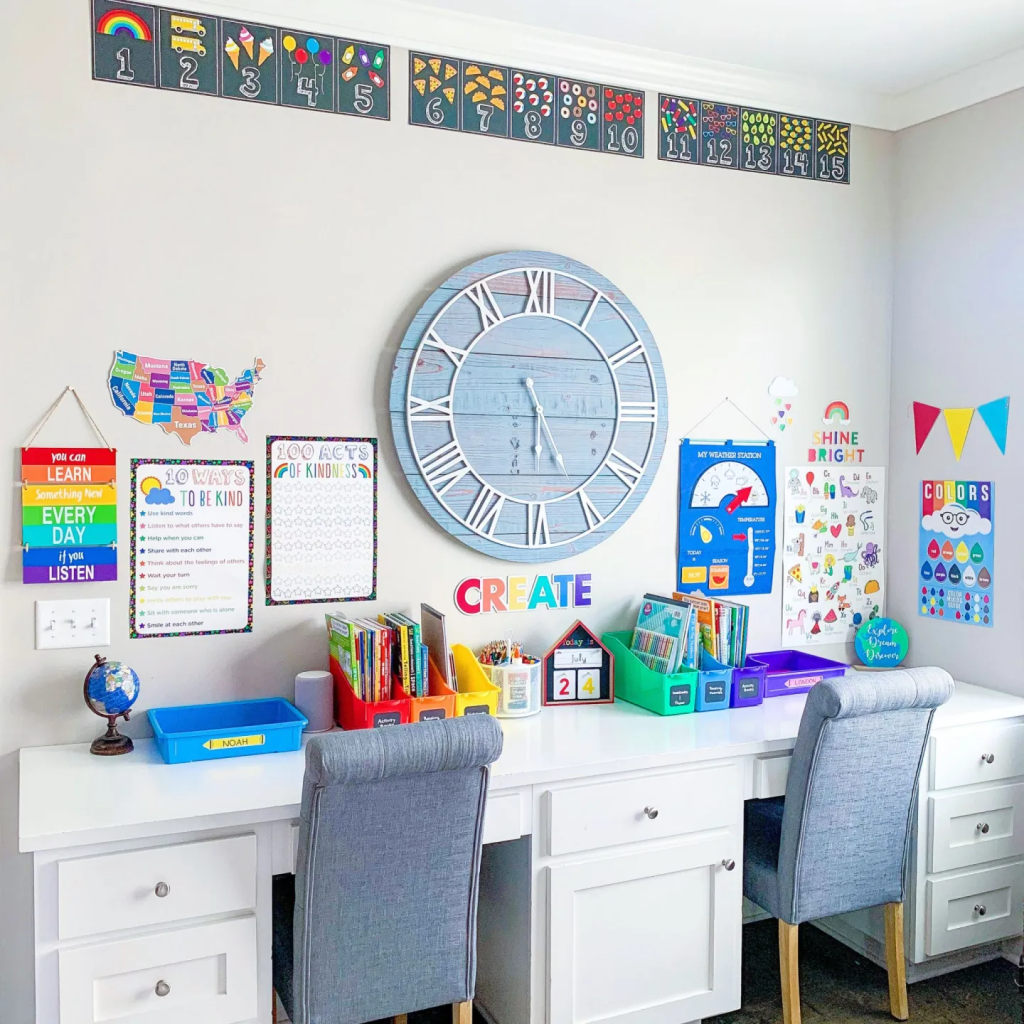
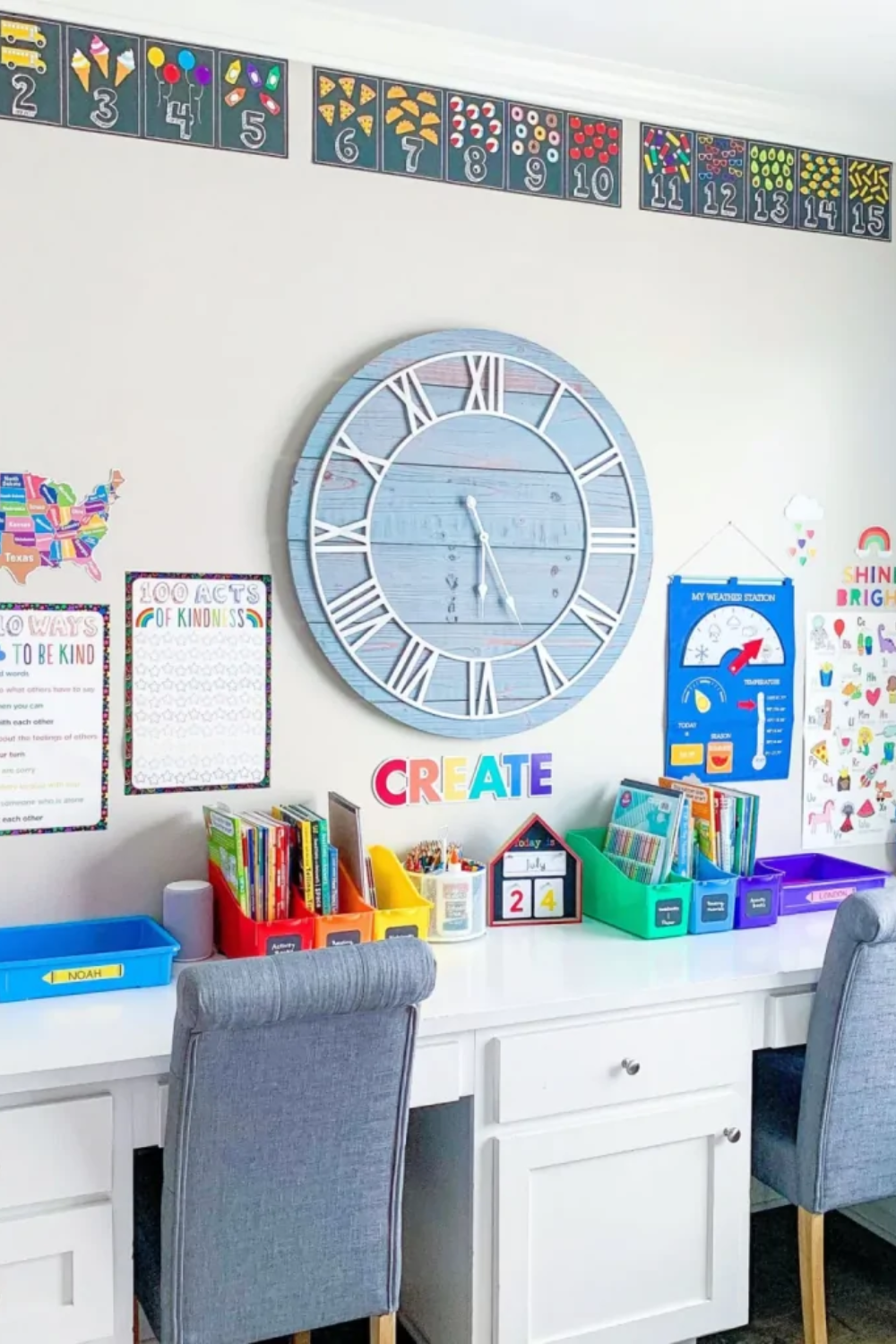
10. Use Visual Learning Tools as Decor In a homeschool room, wall space is curriculum. This room treats every inch of wall as a teaching surface: a number frieze runs the full width, a clock teaches time-telling, a US map builds geography, a weather chart builds daily observation habits, and motivational posters set the tone. None of it feels cluttered because it is all purposeful and consistently styled. The key principle here is to put on the walls only what you are actively teaching — rotate displays as the curriculum moves forward, and the room stays fresh and relevant all year.
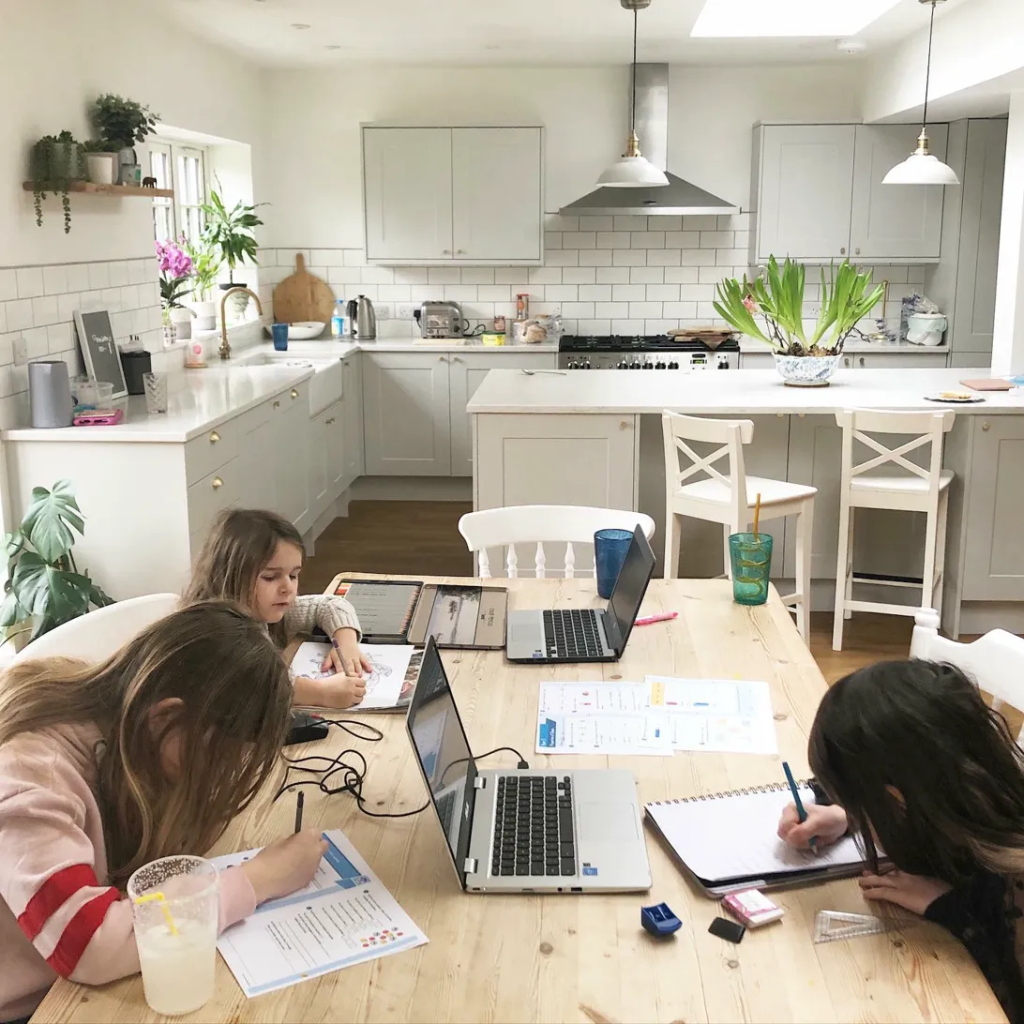
This image is the most honest in the collection. Three children working productively at a kitchen table — laptops open, notebooks out, completely absorbed — is a reminder that the foundation of a good homeschool is not a room at all. It is routine, materials, and presence. A well-lit table with enough surface space for each child, a consistent start time, and the right resources will outperform a beautifully decorated room that lacks structure every single time. Start here if you are just beginning, and add dedicated space only if and when the need becomes clear.
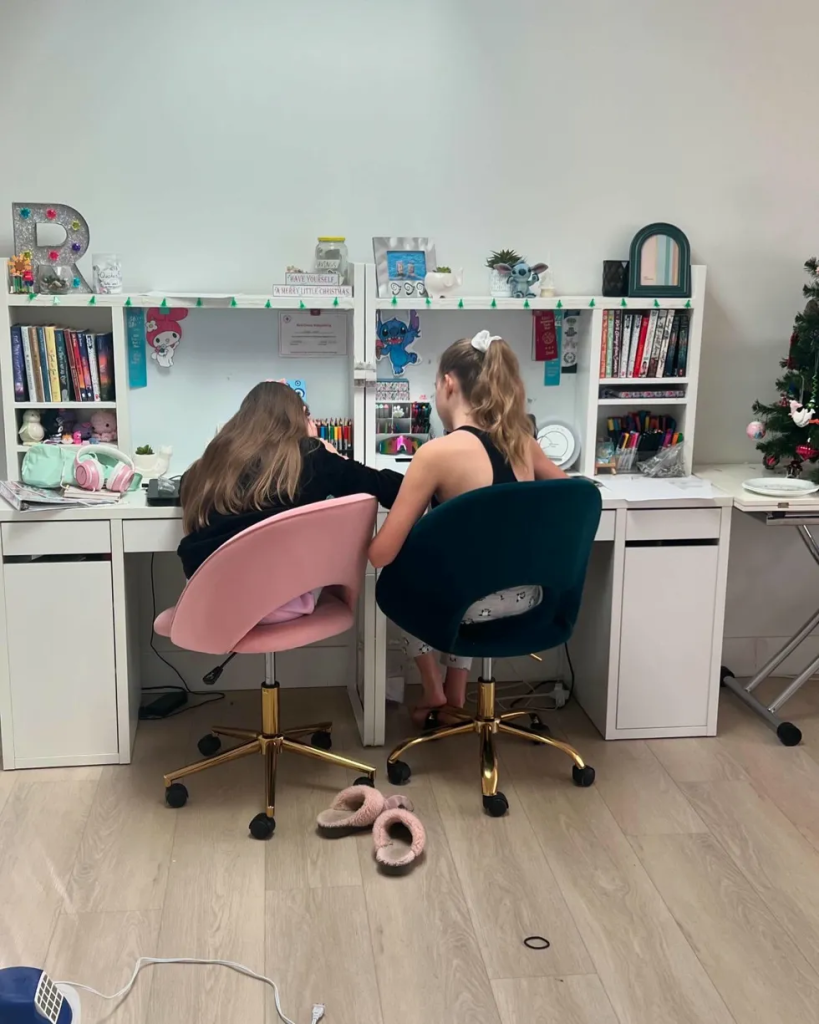
13. Personalisation Drives Engagement When children have genuine input into how their workspace looks and feels, they are more likely to want to be in it. These two sisters have clearly designed their own sides of a shared desk — favourite characters, chosen colours, personal books, and individual decorative items that reflect who each of them is. The result is two distinct personalities sitting side by side, each fully at home in their space. Letting children personalise their workspace is not indulgence — it is one of the simplest and most effective engagement tools available to a homeschooling parent.
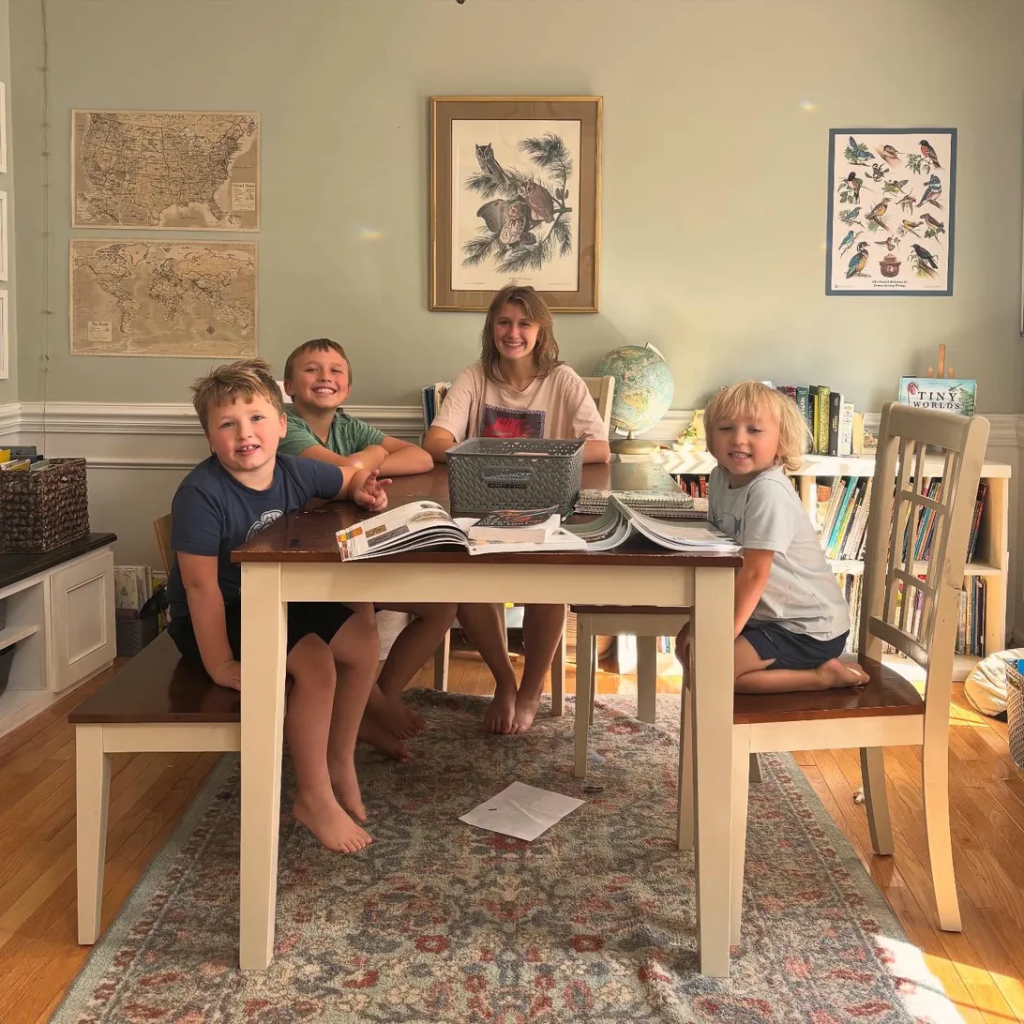
14. Keep the Environment Calm and Curiosity-Led This room makes no attempt to be a classroom. Soft sage walls, natural wood, botanical prints, maps, and overflowing bookshelves create an atmosphere that is closer to a well-loved library than a school. The message it sends to children is that learning is a natural, unhurried part of life — not a performance or a chore. For families who want to avoid the institutional feel of a formal classroom setup, this kind of curiosity-led environment, where interesting things are simply always within reach, is one of the most powerful learning contexts you can create.
The Room You Already Have Is Enough to Start
It would be a disservice to end this guide without saying plainly: you do not need any of this to begin homeschooling well. The most quietly powerful image in this collection is the one that shows three children working at a kitchen table — laptops open, notebooks out, fully absorbed — in a bright, ordinary kitchen with nothing purpose-built about it at all. No accent wall. No zoned layout. No balance ball chairs or rotating curriculum displays.
Just a well-lit surface, the right materials, a consistent routine, and a parent who showed up.
Everything else in this guide is about optimising an experience that already works at that kitchen table. The accent wall helps with focus. The zoned layout helps with multiple children. The personalised desk helps with ownership and engagement. But none of it is a prerequisite. None of it is the point.
The point is the learning — and that can happen anywhere.
Start with what you have. Observe what creates friction. Fix the friction. The room will become what it needs to be over time, shaped by the real daily experience of your particular family rather than by any article’s idea of what a homeschool room should look like.
Quick Reference: What Each Room Teaches You
| Room | Core Principle |
|---|---|
| Accent wall setup | Visual boundaries create learning zones without a separate room |
| Natural light desk | Light quality is a functional requirement, not an aesthetic one |
| Vintage schoolhouse | Room aesthetics communicate values to children daily |
| Young learner corner | Design for the child’s body and independence, not adult convenience |
| Farmhouse zones | Different activities need different physical homes |
| White command centre | Storage systems are the foundation, not the finishing touch |
| Multi-child learning zone | The room must support independent work, not just direct teaching |
| Sibling studio | Clear physical boundaries eliminate shared-space conflict |
| Active learning classroom | Seating choice improves focus for kinaesthetic learners |
| Rainbow inspiration wall | Wall space is curriculum — rotate it as the teaching moves forward |
FAQs: Homeschool Room & Homeschooling Basics
How do I create a homeschool room?
Start by assessing your available space (even a closet or corner works!). Prioritize organization with vertical storage, flexible seating, and zones for different subjects (e.g., reading nook, art station). Involve your child in decorating to build excitement—think themed bulletin boards or a “learning ladder” to track goals.
How do you create a homeschool?
Beyond the physical space, homeschooling requires:
Legal compliance: Check your state’s requirements for paperwork, subjects, and assessments.
Curriculum selection: Tailor materials to your child’s learning style (online programs, hands-on kits, etc.).
Routine building: Set consistent hours but stay flexible for spontaneous learning moments.
What’s the best age to start homeschooling?
There’s no “perfect” age! Many families begin in preschool to nurture curiosity early, while others transition during elementary or middle school due to social, academic, or lifestyle needs. Focus on your child’s readiness and your confidence to guide them.
What’s a good name for a homeschool?
Choose something meaningful:
Family-based: “Smith Family Academy”
Values-driven: “Bright Horizons Learning”
Location-inspired: “Maplewood Homeschool”
Whimsical: “Curiosity Cottage”
What’s the best part of homeschooling?
Flexibility! You can:
Adapt lessons to your child’s pace.
Explore topics deeply (spend a week on dinosaurs if they’re obsessed!).
Bond through shared experiences like field trips or cooking chemistry.
What’s another word for homeschool?
Common alternatives include:
Home education
Home-based learning
Independent learning
Unschooling (child-led, interest-focused approach)
Conclusion
Designing a homeschool room is less about perfection and more about creating a flexible, evolving space that reflects your child’s journey. Whether you’re carving out a nature-themed nook or a tech-savvy hub, remember: the best classrooms adapt. Celebrate small wins (yes, even surviving glitter spills!), and don’t shy away from tweaking setups as your family grows. By avoiding common pitfalls and leaning into the benefits of structure, you’ll build a space where curiosity isn’t just nurtured—it’s unstoppable. Here’s to learning adventures ahead!