
Dragons have captivated human imagination for millennia. From the serpentine lung dragons of Asian folklore to the fire-breathing beasts of European legend, these mythical creatures offer endless inspiration for woodcarvers. Whether you’re just starting your carving journey or you’re a seasoned veteran looking for your next challenge, dragon carvings provide the perfect blend of artistic expression and technical skill development.
In this article, we’ll explore 25 dragon wood carving ideas organized by skill level, complete with project descriptions, tool recommendations, and tips to bring these mythical creatures to life.
Why Carve Dragons?
Dragon carvings remain perennially popular for several reasons:
- Versatility: Dragons can be stylized or realistic, fierce or friendly, simple or extraordinarily detailed
- Scale flexibility: From tiny pendants to life-sized sculptures
- Cultural appeal: Universal recognition across cultures
- Practice opportunities: Scales, wings, claws, and expressions challenge every carving skill
- Marketability: Dragon carvings consistently sell well at craft shows and online
Before You Begin: Essential Tools for Dragon Carving
Beginner’s Toolkit
- Carving knife: A quality fixed-blade knife (3-4″ blade)
- Detail knives: 2-3 smaller blades for tight spaces
- Gouges: #3 and #5 sweep in 6mm and 12mm sizes
- V-tool: For texture and scale definition
- Sharpening supplies: Strop and compound (sharp tools are SAFE tools)
- Safety gear: Cut-resistant gloves and thumb guard
Intermediate Additions
- Micro carving tools: For fine detail work
- Reciprocating carver: For faster material removal
- Burr set: If using rotary tools
- Specialty gouges: Back-bent and spoon-bent for difficult angles
Wood Selection Guide
| Wood Type | Best For | Characteristics |
|---|---|---|
| Basswood | Beginners, all skill levels | Soft, even grain, holds detail |
| Butternut | Intermediate | Carves like walnut, beautiful color |
| Black Walnut | Advanced | Hard, rich color, takes detail well |
| Cherry | Advanced | Hardens with age, beautiful finish |
| Pine | Practice carvings | Inexpensive but can be splintery |
| Cedar | Outdoor/garden | Aromatic, weather-resistant |
| Tupelo | Detailed carvings | Excellent for fine details |
Beginner Dragon Carving Ideas (Projects 1-8)
1. The Serpentine Wall-Hanger
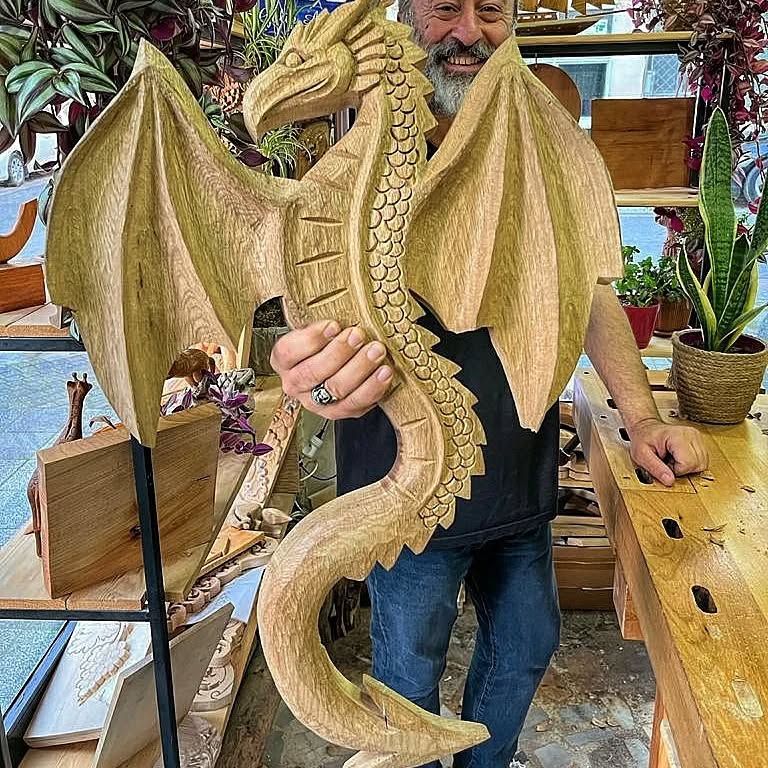
- Description: This project is an excellent introduction to silhouette and flow. By focusing on a “S-curve” serpentine body, you can create a large-scale piece without the structural complexity of a free-standing sculpture. The design emphasizes broad, flat surfaces on the wings—perfect for practicing consistent depth—and a repetitive underbelly pattern that builds muscle memory with your V-tool.
- Skill Focus: Symmetry and Proportional Flow. Learning how to transition the thickness of the body from the heavy neck down to a tapered tail.
2. The Classic Guardian
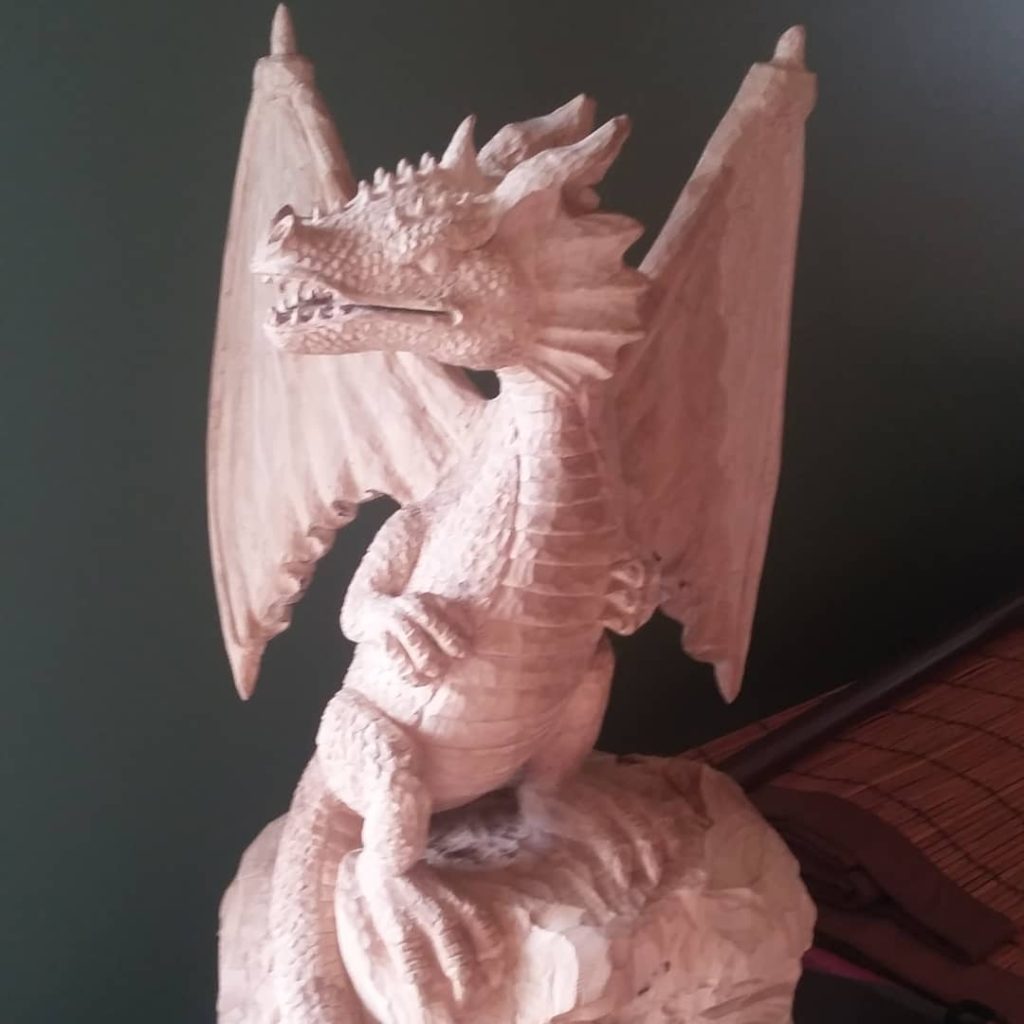
- Description: This piece moves into the realm of 3D form and posture. Sitting upright on a rocky base, this dragon teaches you how to “ground” a carving. It features a great mix of smooth facial planes and sharp, angular horns. The bat-style wings are tucked slightly, which provides more structural integrity and makes it a safer project for those still learning the limits of wood grain.
- Skill Focus: Anatomical Blocking. Understanding how to position the legs and torso to create a sense of weight and balance in a vertical sculpture.
3. The Shadow Monarch Bust
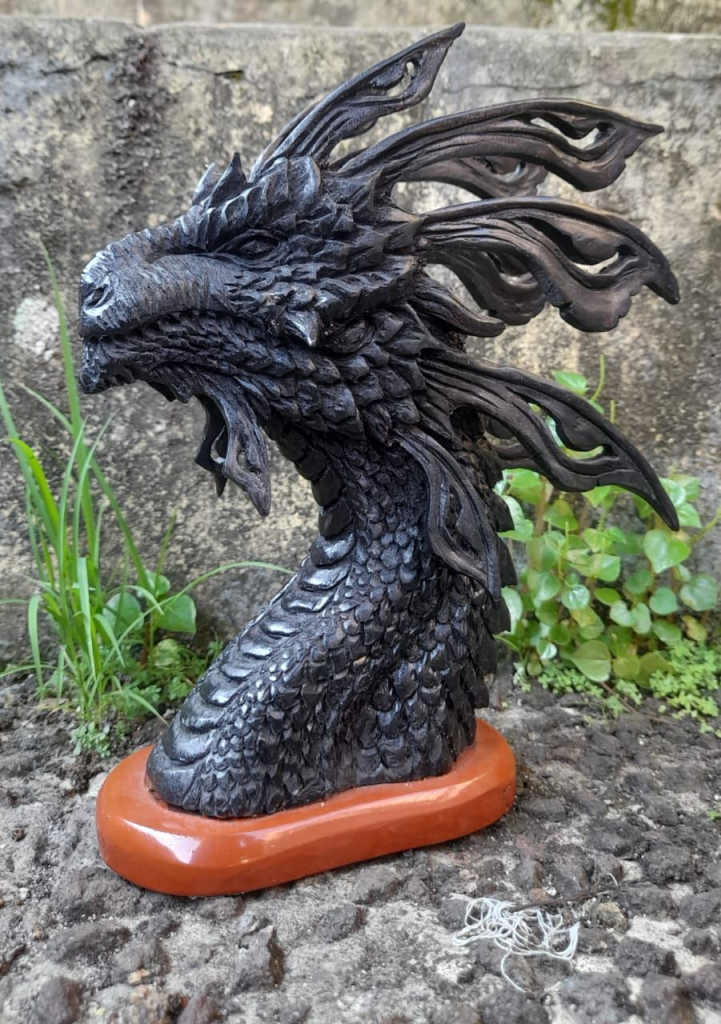
- Description: For the carver who loves fine detail and texture, this bust is the ultimate challenge. Instead of worrying about a full body, you can pour all your focus into the “personality” of the dragon. This piece features deep, layered scales and intricate, flame-like head crests that utilize negative space (the gaps between the horns). A dark finish or wood-burning can be used here to hide grain transitions and emphasize the “monstrous” aesthetic.
- Skill Focus: Texture Layering. Mastering the overlapping pattern of scales and using delicate “pierced carving” techniques for the flowing mane/horns.
4. The Ornamental Kris Grip
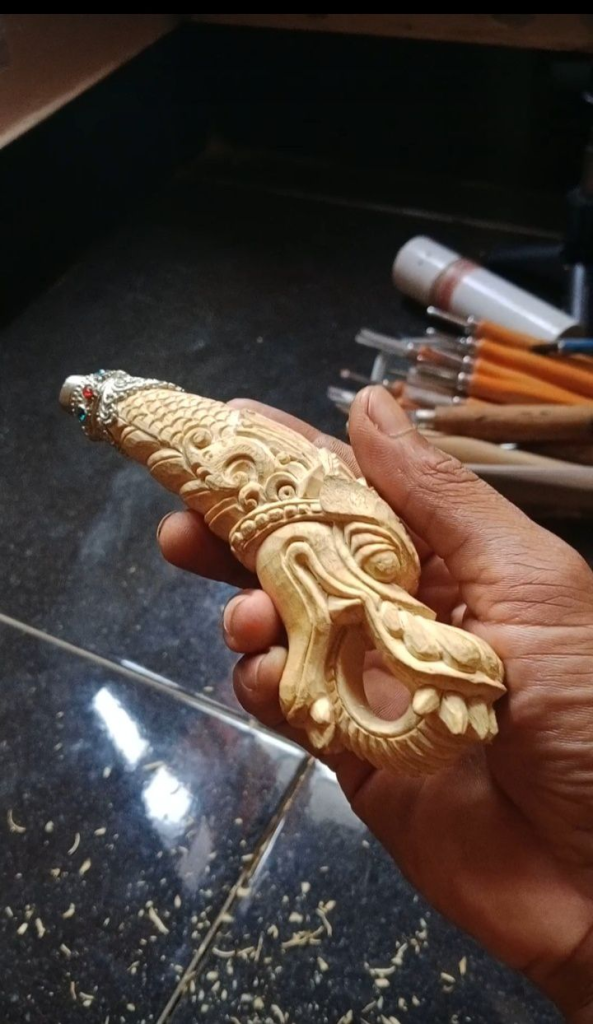
- Description: This project is inspired by traditional Southeast Asian weaponry. It’s a masterclass in miniature detail and ergonomics. Because the carving serves as a handle, every curve must feel comfortable in the hand while still looking fierce. The design features a blend of smooth, bulbous surfaces and sharp, swirling accents around the jawline. Notice how the eye is often set with a small bead or contrasting wood to give it a “spark” of life.
- Skill Focus: Micro-carving and Ergonomics. Learning to balance decorative aesthetic with a functional, comfortable grip.
5. The Cane-Head Wanderer
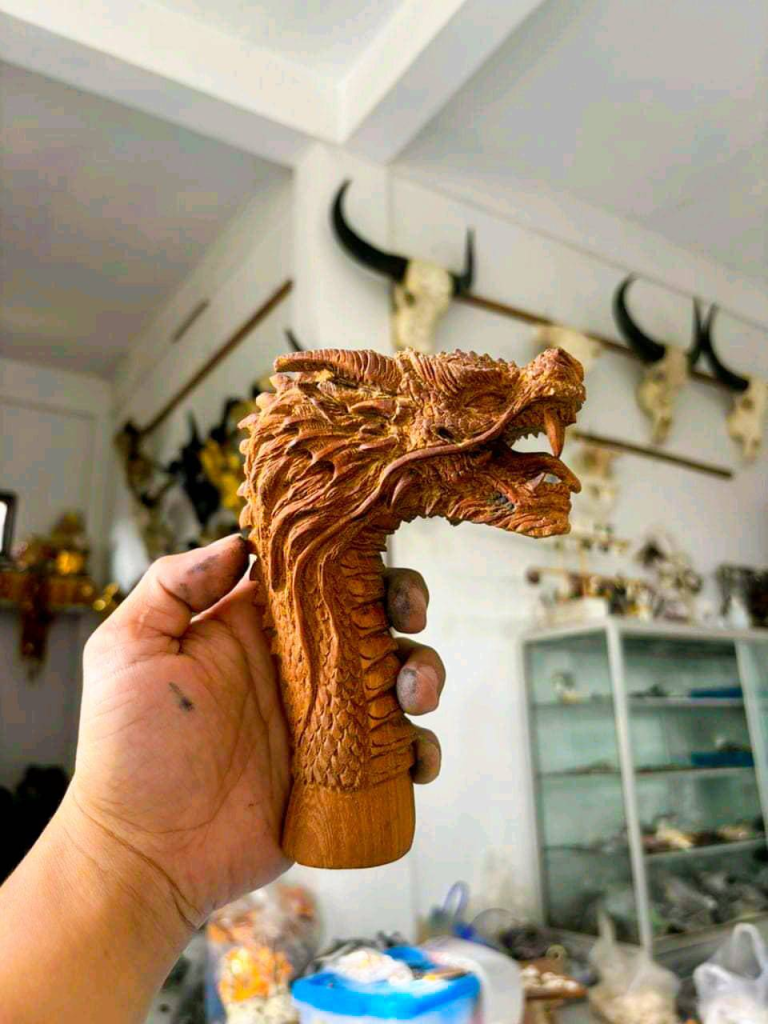
- Description: Turning a walking stick into a legendary staff is a rite of passage for many woodcarvers. This design focuses on a powerful, open-mouthed expression and deep, overlapping scales that wrap around a cylindrical form. Working on a curved surface like a cane head requires you to constantly rotate your piece, which is a great way to practice 3D spatial awareness. The open jaw also provides a fantastic opportunity to practice carving teeth and a tongue without the fragility of a full-body sculpture.
- Skill Focus: Cylindrical Composition. Learning how to wrap a complex pattern (scales and mane) seamlessly around a round object.
6. The Celestial Pearl Seeker
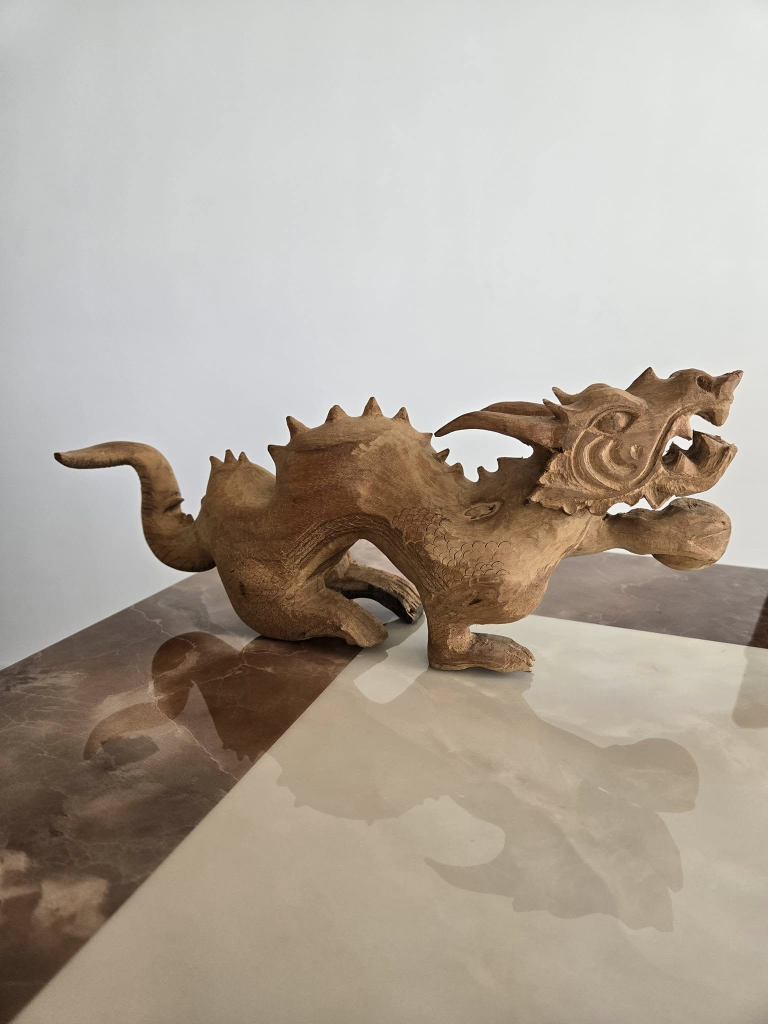
- Description: This Eastern-inspired design is a masterclass in stylized form. Rather than getting bogged down in hyper-realistic anatomy, this project uses bold, sweeping lines and geometric shapes to convey power. The dragon is depicted in a classic “stalking” pose, clutching the mythical pearl—a symbol of wisdom. The smooth, matte finish highlights the clean transitions between the humped back and the sharp, triangular dorsal spikes. It’s a fantastic project for carvers who want to practice creating a sense of movement and “flow” without the stress of microscopic detail.
- Skill Focus: Simplification and Surface Sanding. Learning how to strip a creature down to its essential silhouette while maintaining its iconic character.
7. The High-Fantasy Sentinel
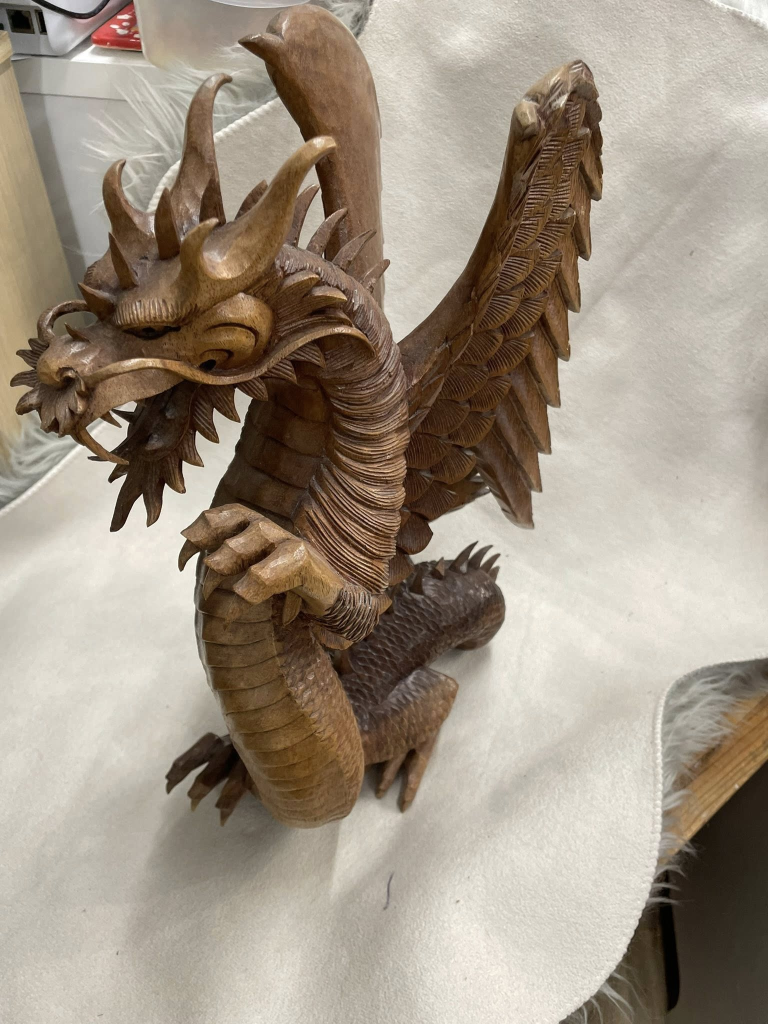
- Description: This is a comprehensive project for the carver ready to bridge the gap between intermediate and advanced. This Western-style dragon features aggressive verticality, with upright wings and a coiled, muscular neck. Note the incredible contrast between the smooth, segmented underbelly and the sharp, serrated edges of the wings. The inclusion of fine whiskers and individual claws requires a patient hand and a very sharp detail knife. This piece doesn’t just sit; it commands the space it occupies.
- Skill Focus: Contrast and Negative Space. Mastering the interplay between deep “undercuts” (the space behind the neck and wings) and high-relief textures.
8. The Netsuke-Style Curled Dragon
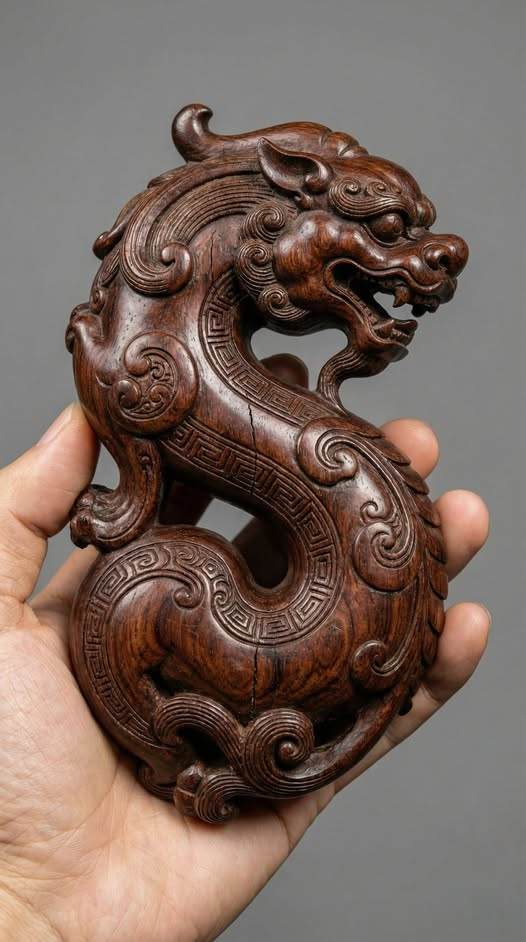
- Description: Inspired by the Japanese art of Netsuke, this compact carving is designed to be smooth and tactile. The dragon is coiled into a tight “O” shape, which is not only aesthetically pleasing but also makes the piece incredibly durable—no thin wings or tails to snap off. This project is perfect for practicing continuous grain flow as you carve the body winding over and under itself.
- Skill Focus: Interlocking Forms. Learning how to carve parts of the body that appear to pass behind or through other sections, creating a true 3D knot.
9. The Gemstone Guardian Pendant
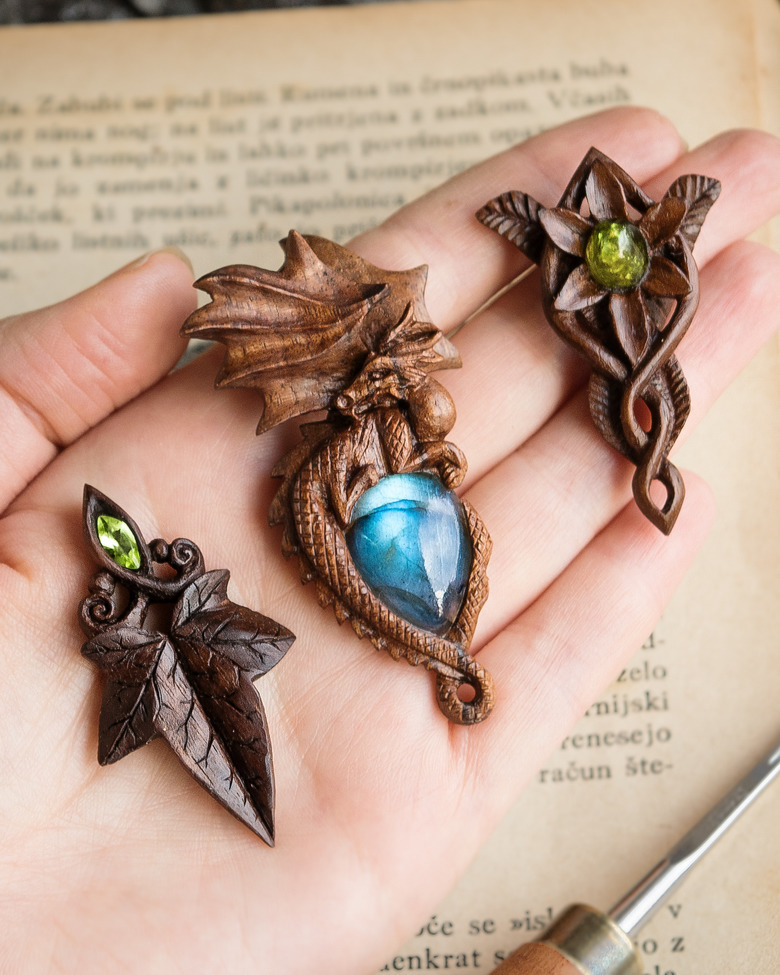
- Description: This project introduces the exciting world of mixed media. Here, the dragon is carved as a delicate frame for a cabochon stone (like Labradorite). This is a high-reward project for those with a steady hand and micro-tools. It challenges the carver to create a secure “seat” for the stone while maintaining the tiny details of the dragon’s wings and scales.
- Skill Focus: Inlay and Mounting. Precise measurement and carving to fit a non-wood object perfectly into your design.
10. The Medallion Scrollwork
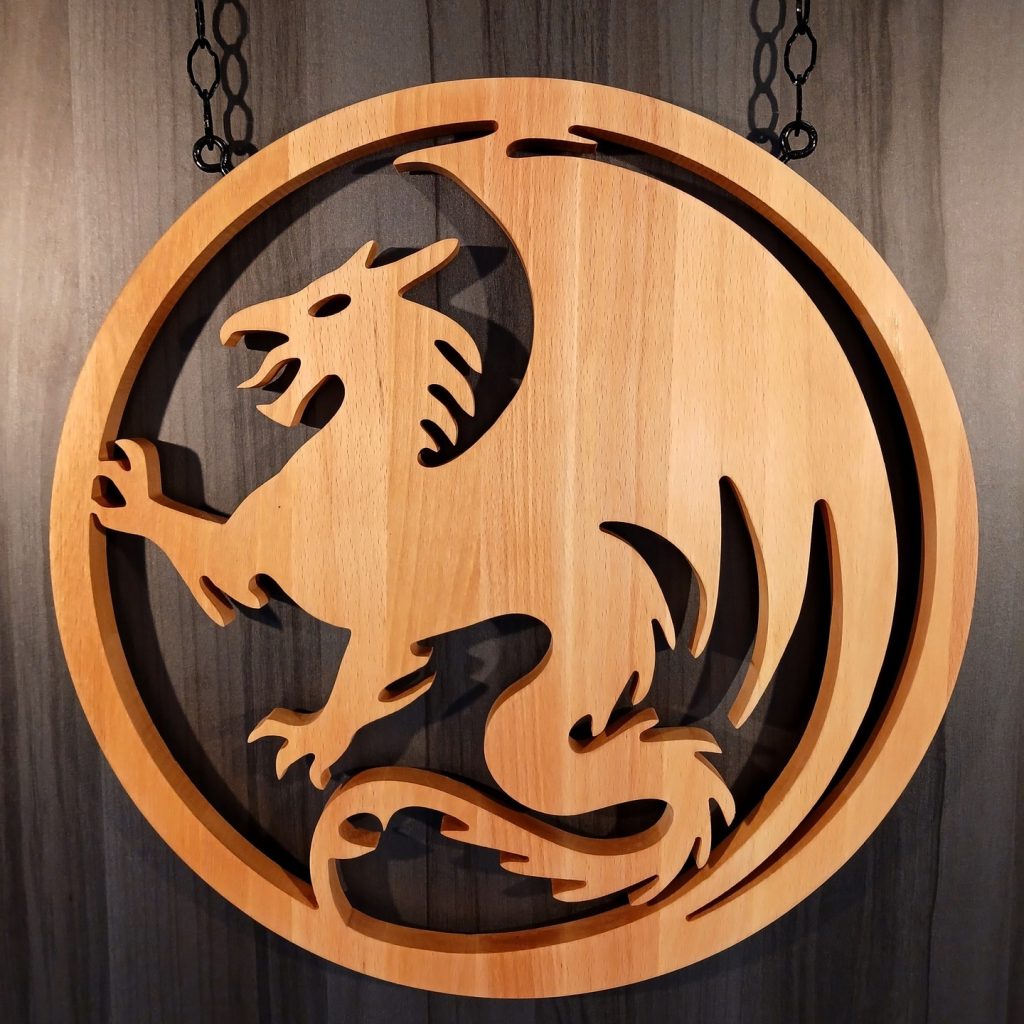
- Description: If you prefer working in two dimensions, this pierced relief medallion is a great choice. Instead of a fully 3D sculpture, this dragon is carved within a circular frame, using a scroll saw or coping saw to remove the background (negative space). This technique emphasizes the dragon’s silhouette and is perfect for wall decor or even as a template for a larger furniture inlay.
- Skill Focus: Fretwork and Negative Space. Mastering the use of “windows” to define the shape of the creature against its background.
11. The Sculptural Walking Stick Head
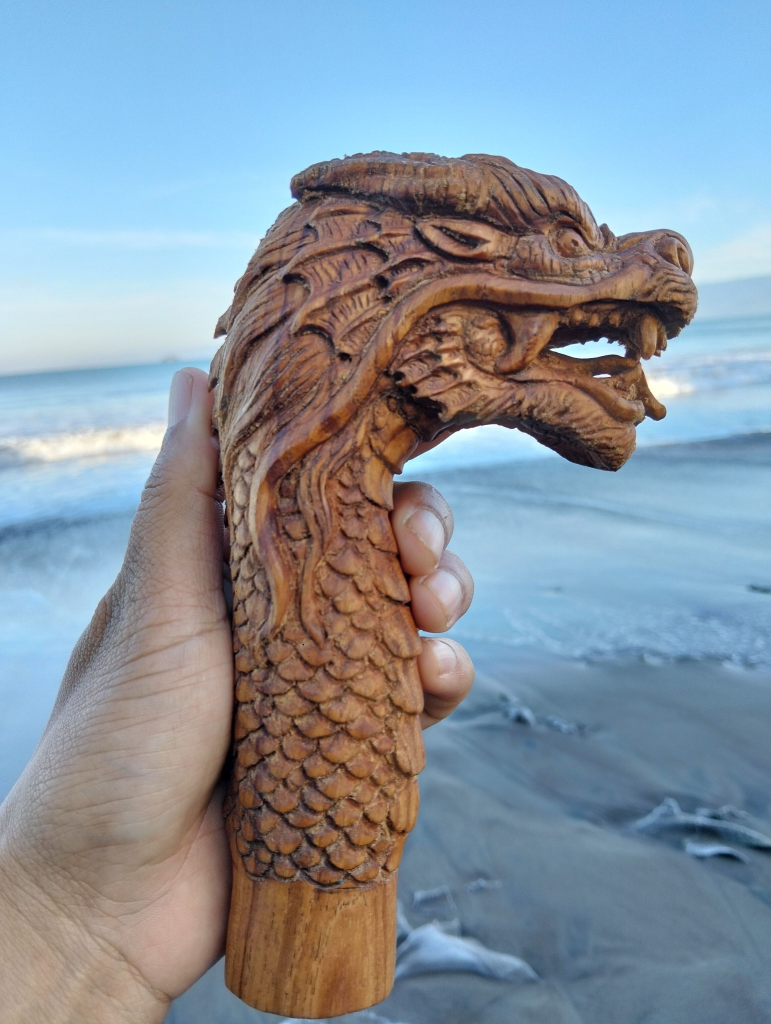
(Note: This is a high-detail look at the cane-head concept from earlier, perfect for emphasizing textural contrast.)
- Description: This close-up shows the power of deep relief carving. By deeply incising the space between the jaw and the neck, you create a shadow that makes the head “pop” from the staff. The scales here are uniform and rhythmic, which is a great exercise for carvers looking to improve their consistency with a small gouge or V-tool.
- Skill Focus: Deep Relief and Undercutting. Learning how to create heavy shadows that make a carving visible from a distance.
12. The Geometric “Flat-Plane” Hatchling
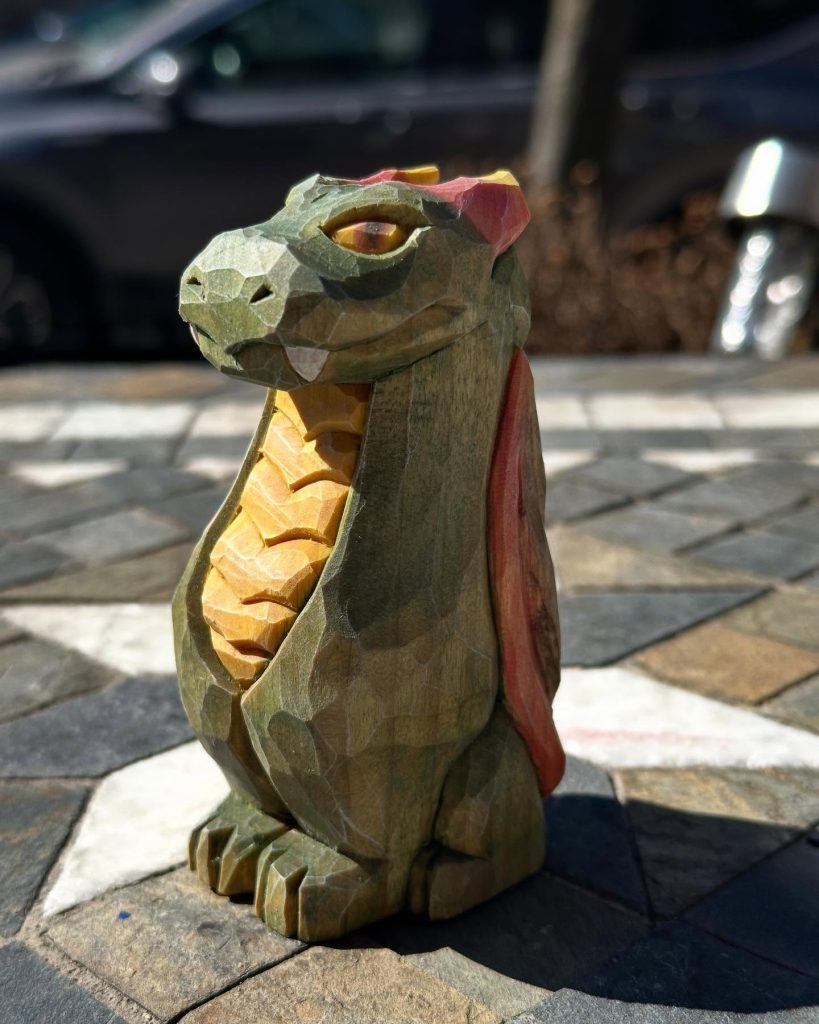
- Description: This project is a fantastic introduction to the Scandinavian Flat-Plane style. Instead of sanding everything smooth, you leave the knife marks visible to define the dragon’s muscles and features. The chunky, blocky feet and the large, simplified eyes (which can be painted or inlaid with beads) give this dragon a charming, “folk-art” personality. It’s low-stress and high-reward.
- Skill Focus: Knife Control. Learning to make every cut count without relying on sandpaper to “fix” the form.
13. The Low-Profile Crested Dragon
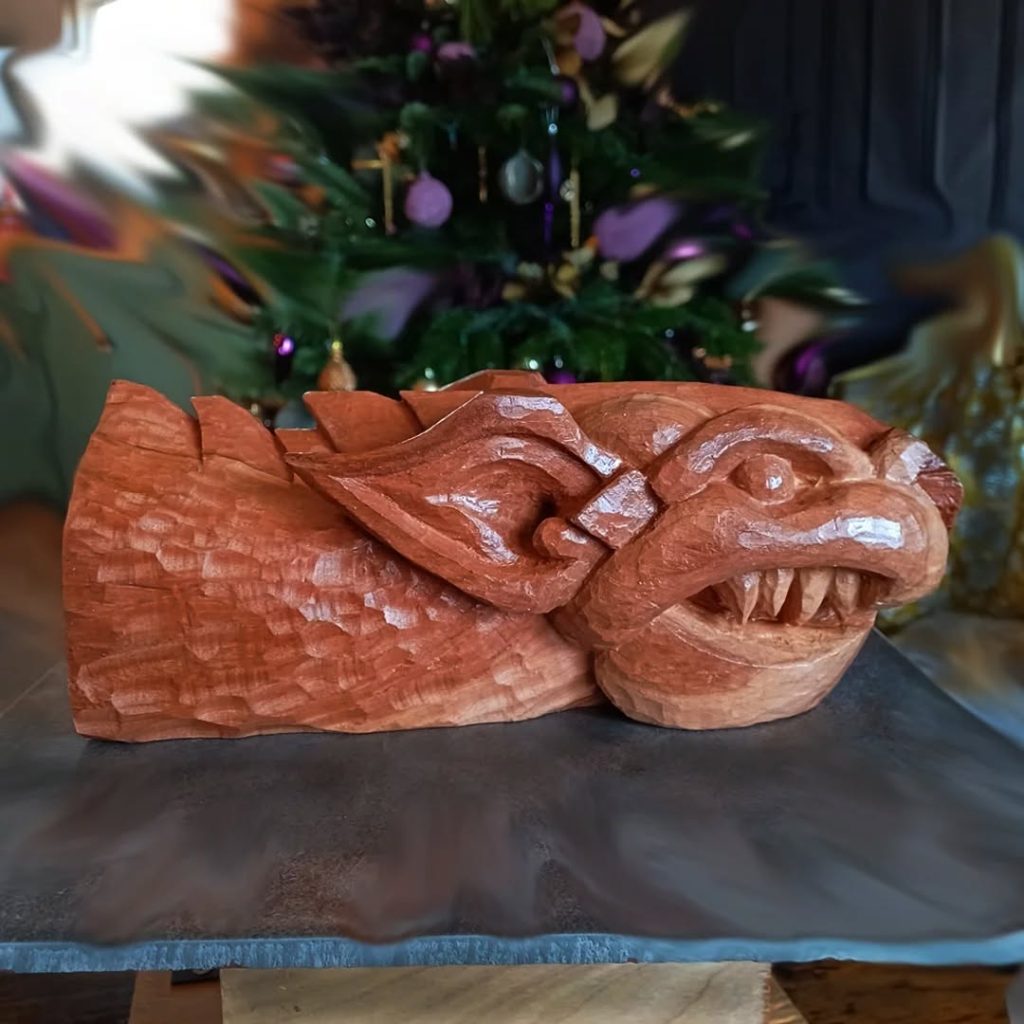
- Description: This design is ideal for working with thicker slabs or offcuts of wood where you don’t have much height to play with. It focuses on a horizontal composition, with the dragon’s head and mane flowing backward along the grain. The wide, flat scales on the neck are much easier for beginners to manage than tiny, overlapping ones, and the large, rounded eye provides a great surface for practicing smooth, convex curves.
- Skill Focus: Grain Direction Awareness. Learning how to carve long, sweeping details like the mane and horns without chipping the wood against the grain.
14. The Flowing Ribbon Wyvern
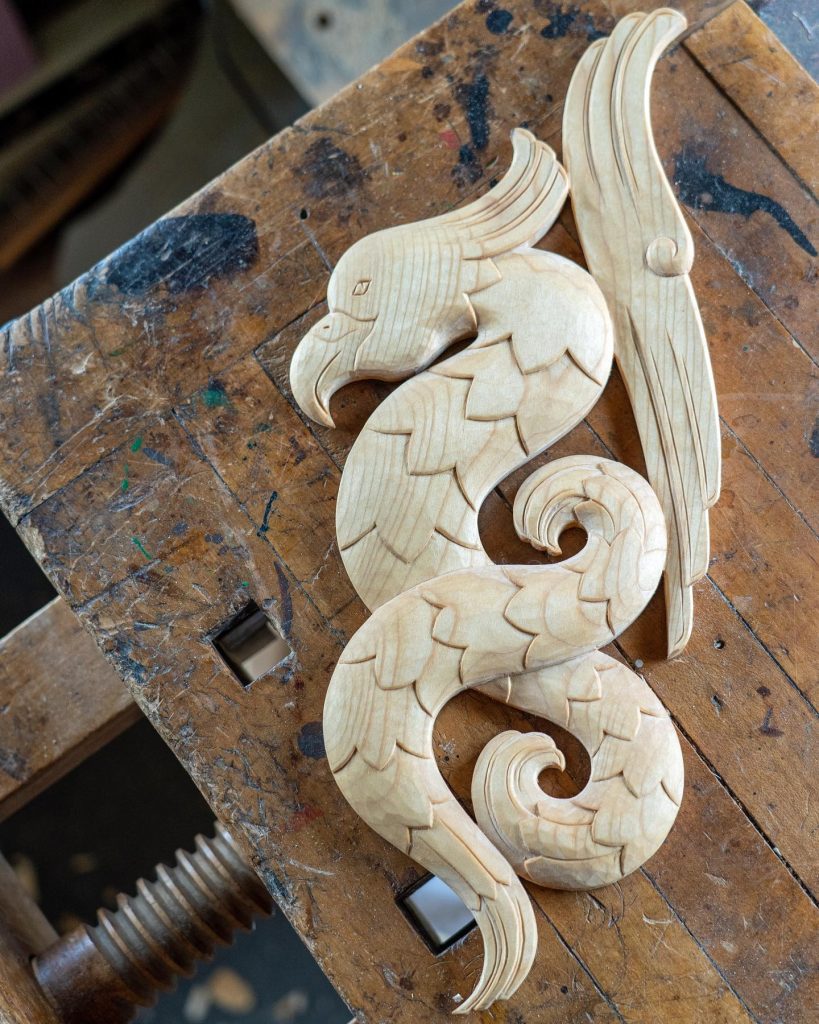
- Description: This project is all about liquid motion. Carved in a light-colored wood like Basswood or Pine, it uses large, overlapping scales and a tightly coiled tail to create a sense of rhythm. The wings are kept simple and streamlined, making it a great exercise for those who want to practice smooth transitions between different planes without getting bogged down in microscopic details. It’s an ideal design for a wall plaque or a decorative box lid.
- Skill Focus: Line Weight and Surface Finishing. Learning how to use a V-tool to create clean, flowing lines that guide the viewer’s eye through the entire length of the carving.
15. The Whimsical “Cartoon” Companion
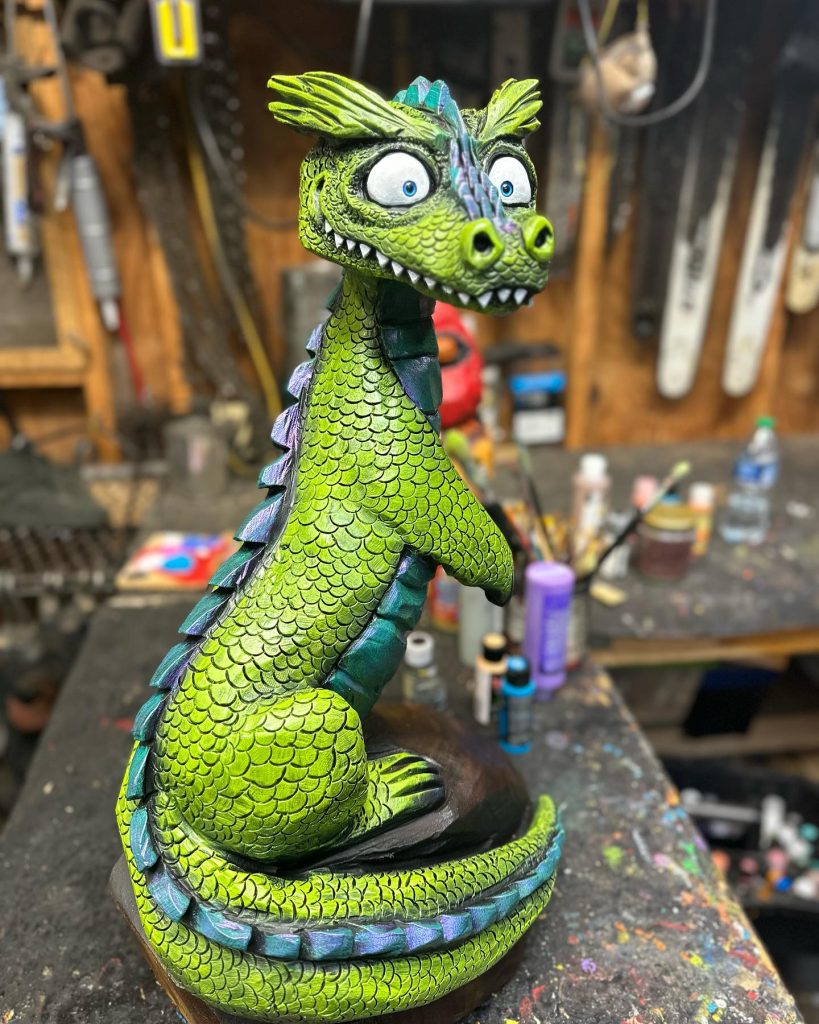
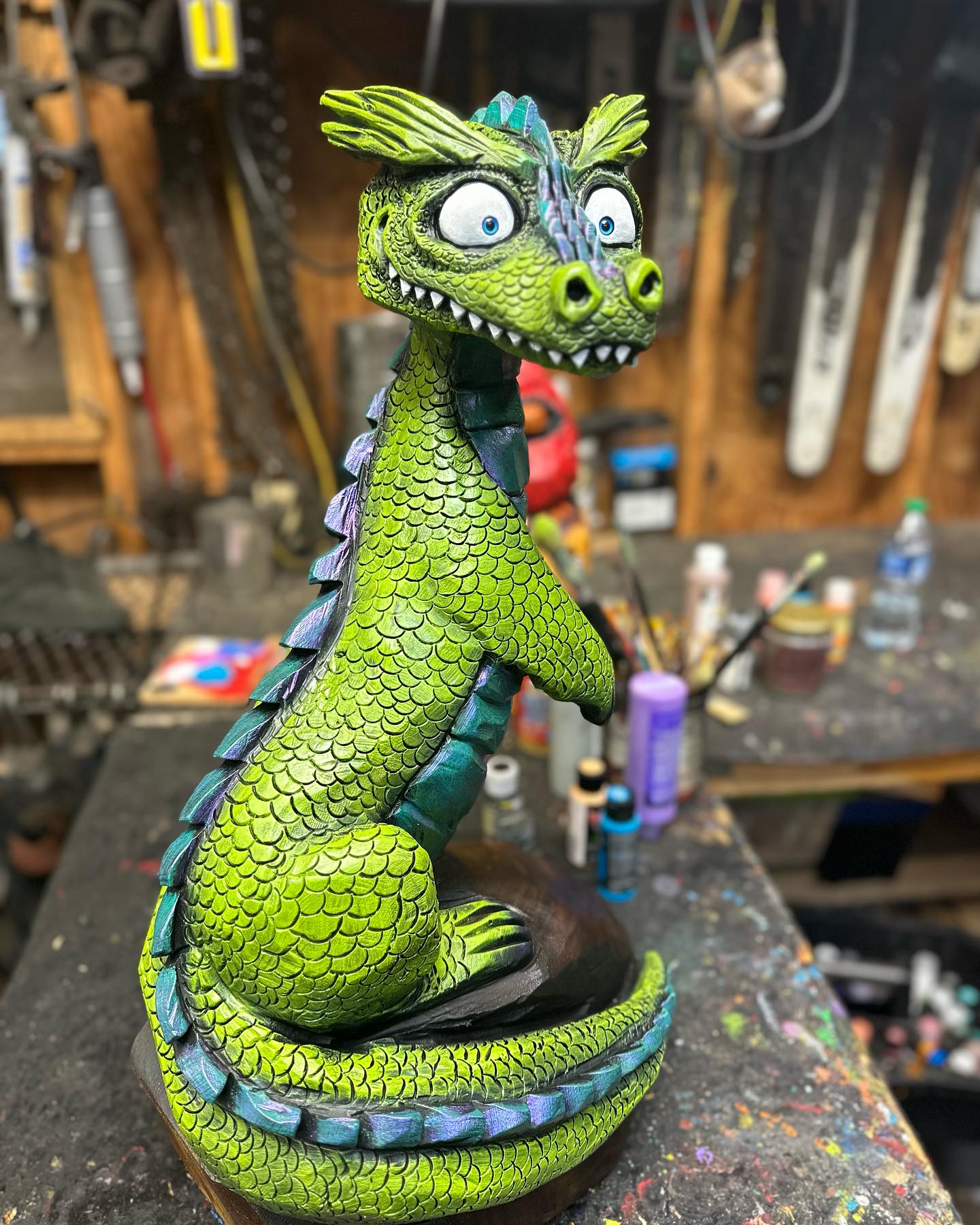
- Description: Dragons don’t always have to be fierce! This project is perfect for the character carver. It features exaggerated proportions—a large head, expressive wide eyes, and a slightly toothy grin. This piece is designed specifically to be painted, allowing you to hide any minor carving imperfections under a vibrant coat of acrylics. The contrast between the lime green scales and the purple dorsal fins makes this a standout piece for a child’s room or a bookshelf.
- Skill Focus: Expression and Painting Techniques. Focusing on the “emotional” impact of a carving and practicing advanced finishing techniques like dry-brushing to make individual scales pop.
Dragon Anatomy for Carvers
Understanding basic dragon anatomy helps create believable creatures, even in fantasy:
Eastern Dragon Characteristics
- Long, serpentine body
- Four short legs with clawed feet
- Antler-like horns
- Whiskers and mane
- Flowing, flame-like appendages
- Often shown with a pearl or flame
Western Dragon Characteristics
- Reptilian body
- Four legs (wyverns have two)
- Bat-like wings
- Horned head
- Spiked tail
- Armored scales or plates
Common Elements
- Expressive eyes (often carved separately and inlaid)
- Nostrils that suggest fire-breathing
- Claws that convey power
- Scales that follow body contours
Finishing Techniques
Your carving deserves a beautiful finish. Consider these options:
For Natural Wood
- Danish oil: Penetrating finish that highlights grain
- Tung oil: Durable, slightly glossy
- Shellac: Traditional, warm finish
- Wax: Soft sheen, pleasant feel
For Painted Dragons
- Acrylic paints: Water-based, easy to control
- Airbrushing: Smooth gradients for wings
- Dry brushing: Highlights texture and scales
- Metallics: Gold, bronze, or silver for accents
For Burned Details
- Woodburning pen: Add scales, texture, or patterns
- Shading tips: Create depth and dimension
- Branding: Consider a maker’s mark on the base
Troubleshooting Common Dragon Carving Challenges
“My dragon looks like a lizard with wings”
Study dragon art and focus on the elements that say “dragon”—horns, expressive brows, nostril flares, and wing structure separate dragons from mundane reptiles.
“The wings keep breaking”
Wings are vulnerable. Consider:
- Carving wings with the grain
- Adding structural support with wire
- Making wings slightly thicker
- Positioning wings close to the body
“Scales look repetitive and boring”
Vary scale size according to location—smaller on the head, larger on the body, transitioning sizes along the tail. Use different texturing tools for variety.
“The expression isn’t fierce enough”
Eyes make the dragon. Consider:
- Deep-set eyes with heavy brows
- Narrowed pupils
- Flared nostrils
- Slightly open mouth showing teeth
Display and Photography Tips
Once your dragon is complete:
- Light from the side to emphasize texture and shadows
- Use a simple background that doesn’t compete with detail
- Photograph at dragon’s eye level for dramatic effect
- Consider a custom base that complements the theme
- Sign your work—you earned it!
Next Steps: Your Dragon Carving Journey
Whether you’ve completed your first simple dragon bookmark or you’re planning a cathedral-door masterpiece, remember that every expert was once a beginner. Dragon carving is a journey of continuous improvement, where each project teaches new skills and reveals new possibilities.
We’d love to see your dragon carvings! Share your projects in the comments below or tag us on social media.
Unleashing Your Inner Dragon
Whether you’ve chosen to carve a tiny, gemstone-encrusted pendant or a massive, serpentine wall hanging, you are participating in a tradition as old as the wood itself. Dragons are the ultimate subject for a woodcarver because they represent the perfect marriage of nature and imagination.
As you move through these 25 projects, remember that every “mistake” is simply a new texture and every chip of wood on the floor is a step toward mastery. Don’t be afraid to deviate from the patterns—let the grain of the wood suggest the curve of a wing or the flare of a nostril.
The most important tool in your kit isn’t a premium gouge or a high-speed rotary burr; it’s your patience. Take your time, keep your tools sharp, and most importantly, enjoy the process of bringing a legendary creature to life from a simple block of wood.
Your Turn to Create
We hope these ideas have sparked a fire in your workshop! Which dragon style are you planning to tackle first? Do you prefer the smooth, flowing lines of the Eastern lung or the rugged, armored plates of the Western drake?
Share your progress with us! Tag us in your photos or drop a comment below with your favorite wood types for dragon carving. We can’t wait to see what you create.
Happy carving!